20206-06-17 電気通信大学
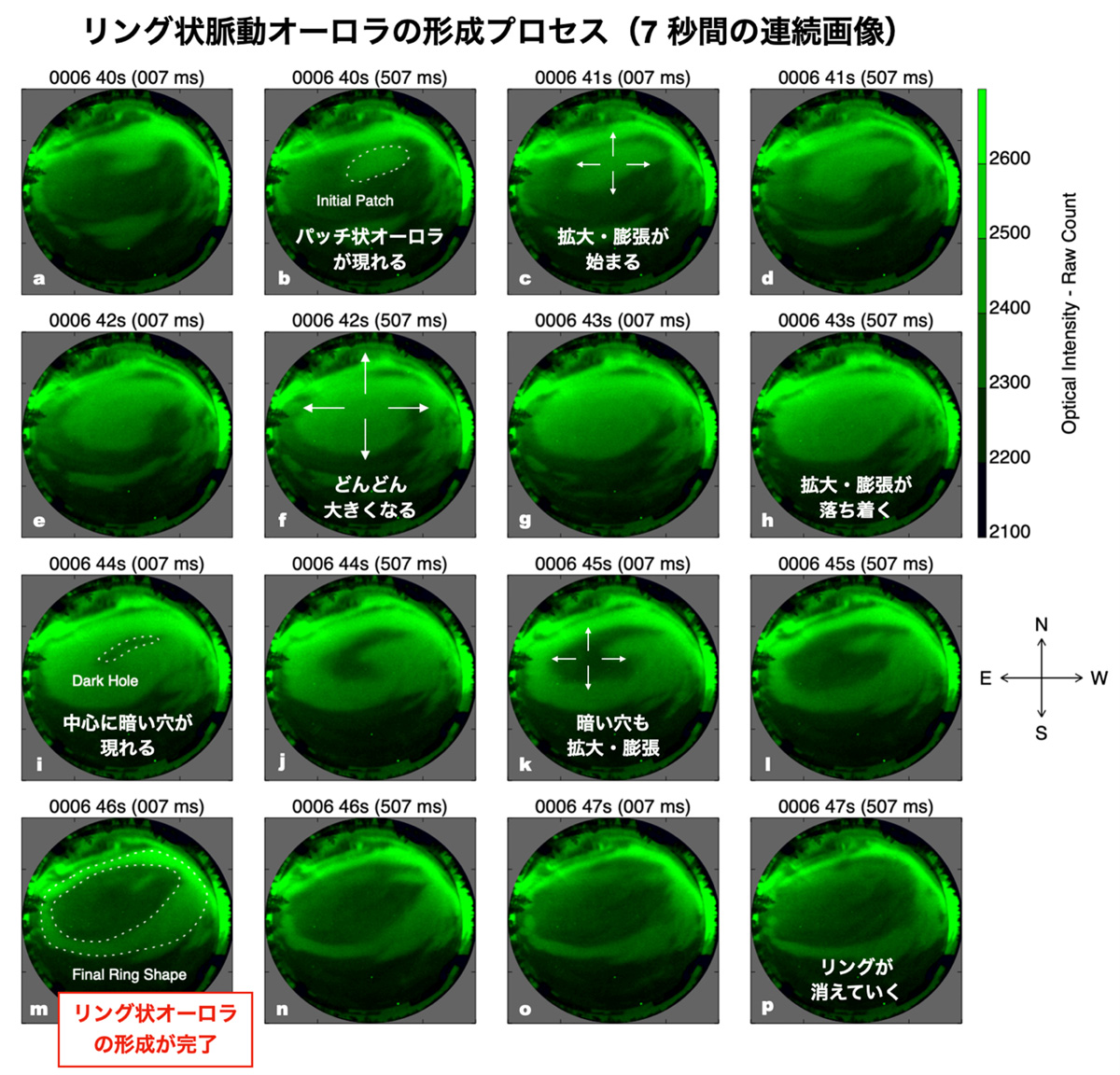
図2:500ミリ秒毎に取得されたオーロラの連続画像。パッチ状のオーロラが出現し、円弧状に拡大しながら、最終的にはリング状の構造になる様子を示しています。
<関連情報>
- https://www.uec.ac.jp/news/newsrelease/2026/20260617_7766.html
- https://agupubs.onlinelibrary.wiley.com/doi/10.1029/2026AV002300
円形に膨張するリング状の脈動オーロラ:宇宙におけるプラズマ波源の可視化 Circularly Expanding Ring-Shaped Pulsating Aurora Visualizing the Source of Plasma Waves in Space
K. Hosokawa, S. Kurita, Y. Miyoshi, S.-I. Oyama, Y. Ogawa, M. Ozaki, Y. Kasahara, Y. Kasaba, S. Yagitani, S. Matsuda, F. Tsuchiya, A. Kumamoto, A. Matsuoka, S. Imajo, T. Raita, E. Turunen,…
AGU Advances Published: 04 June 2026
DOI:https://doi.org/10.1029/2026AV002300
Abstract
Pulsating aurorae are prominent auroral emissions in the polar regions, typically occurring in the morning hours during the recovery phase of auroral substorms. These aurorae usually consist of round-shaped patches of emission, with luminosity that pulsates at intervals ranging from less than a second to several tens of seconds. Here, we present, for the first time, a unique case of a pulsating aurora that expanded radially outward in all the directions and repeatedly formed a ring-shaped structure. The speed of expansion, which was at least several tens of kilometers per second at ionospheric altitudes, cannot be attributed to the horizontal convective motion of plasma in the ionosphere. In the magnetosphere, corresponding to the expanding ring-shaped aurora, the Arase satellite detected successive enhancements of natural electromagnetic waves known as a “chorus.” These chorus waves scatter energetic magnetospheric electrons into the ionosphere, resulting in pulsating diffuse aurorae. Notably, the satellite observed systematic delay in the timing of chorus detections, which suggests that a similar circularly expanding feature existed in space. These simultaneous observations of expanding features in both the ionosphere and the magnetosphere demonstrate that the temporal evolution of the shape of a pulsating aurora manifests the spatiotemporal evolution of the source of plasma waves in space.
Plain Language Summary
Pulsating aurorae are faint, patchy auroral lights that repeatedly turn on and off over polar regions, usually after geomagnetic disturbances. Although their time variations have been studied extensively, how their shapes change in space has remained unclear. Here, we report a unique pulsating aurora that formed a thin ring and expanded rapidly outward in all directions within only a few seconds. This unusual aurora was captured using a high-speed all-sky camera in northern Finland, allowing us to observe its detailed evolution for the first time. At the same time, the Arase satellite observed electromagnetic plasma waves, called chorus waves, in Earth’s magnetosphere. These waves are known to scatter energetic electrons into the atmosphere, producing pulsating aurorae. We found that the chorus waves detected by the satellite appeared with systematic time delays that matched the outward expansion of the auroral ring seen from the ground. This indicates that the source region of the chorus waves in space was itself expanding. Our results suggest that disturbances in the magnetosphere can spread rapidly through plasma waves and directly control the shapes of aurorae observed in the upper atmosphere. This study demonstrates that auroral imaging can be used as a remote tool to visualize dynamic plasma processes occurring more than tens of thousands of kilometers above Earth.