2026-06-16 ペンシルベニア州立大学
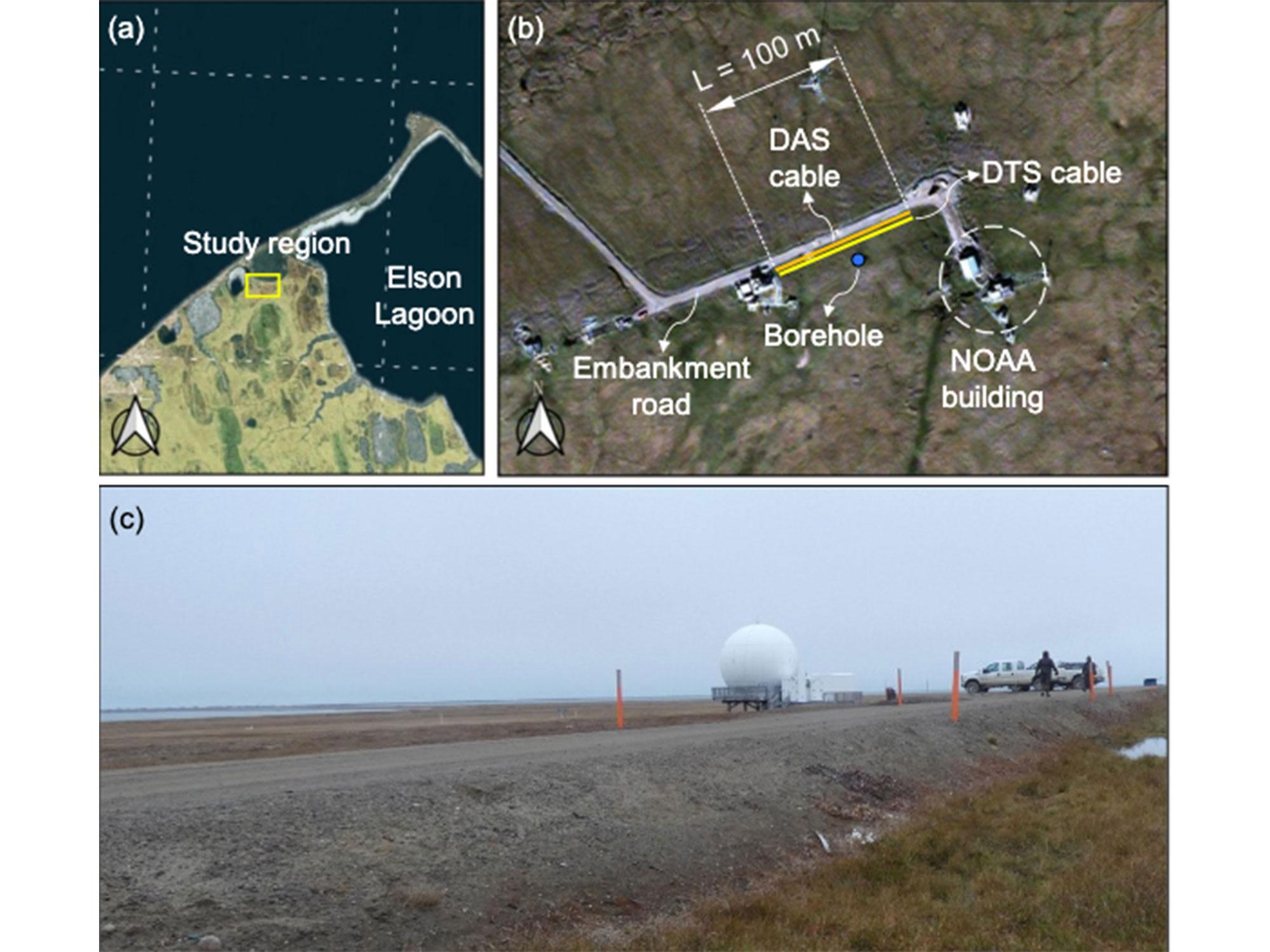
The figure above shows the study location and a map of the cables’ positions relative to the embankment and surrounding research facilities. The marked borehole was used to help the researchers collect data and compare their predictions to field measurements. Credit: Provided by Ming Xiao. All Rights Reserved.
<関連情報>
- https://www.psu.edu/news/research/story/digital-twins-could-help-melt-mystery-alaskas-thawing-permafrost
- https://agupubs.onlinelibrary.wiley.com/doi/10.1029/2025JF008787
アラスカ州ウトキアグヴィクの盛土道路下の永久凍土の熱力学的特性を予測するための物理学に基づいたデジタルツイン Physics-Informed Digital Twin for Predicting Permafrost Thermodynamic Characteristics Under an Embankment Road in Utqiaġvik, Alaska
Lingyun Gou, Ming Xiao, Tieyuan Zhu, Eileen R. Martin, Zhinong Wang, Gabriel Rocha dos Santos, Dmitry Nicolsky, Xiaohang Ji
Journal of Geophysical Research: Earth Surface Published: 24 April 2026
DOI:https://doi.org/10.1029/2025JF008787
Abstract
Arctic permafrost is rapidly degrading in response to global warming. Its thermodynamic evolution governs carbon emissions, hydrological shifts, and terrain stability, with critical consequences for both natural systems and built infrastructure. Accurate prediction of the thermodynamic behavior of permafrost remains elusive, hindered by limited observations and underdeveloped methodologies. Here, we introduce a digital twin framework that integrates differentiable modeling (DM) with high spatial resolution distributed temperature sensing (DTS) data to predict and infer key permafrost characteristics—ground temperature, unfrozen water content, thermal conductivity, and heat capacity. By leveraging a neural-network-based parameterization, our framework fuses observational data with physical heat transfer equations, enabling real-time calibration and updating of the spatiotemporally varying soil thermodynamic characteristics. Applied to permafrost beneath a road embankment in Utqiaġvik, Alaska, the digital twin accurately reconstructs the spatiotemporal evolution of soil temperature fields and captures spatial variability in permafrost thermodynamic properties. The prediction results were further validated against shear-wave velocity distributions inferred from distributed acoustic sensing (DAS), temperature data obtained from borehole thermistors, and thermodynamic properties measured by laboratory testing, demonstrating the framework’s robustness. This work advances the predictive understanding of permafrost dynamics under climate change and establishes a generalizable pathway for digital twin applications in Arctic science.
Plain Language Summary
This study develops a digital twin model to predict how permafrost temperatures change over time. This model integrates physical laws with machine learning and continuously updates itself as new data become available. We apply it to a 100-m-long road embankment in Utqiaġvik, Alaska. The digital twin accurately predicts changes in soil temperature and reconstructs soil temperature fields across space and time. It also captures lateral spatial variability in subsurface conditions and infers key thermodynamic properties, such as unfrozen water content, thermal conductivity, and heat capacity. These estimates are validated using shear-wave velocity profiles and both field and laboratory measurements. Ultimately, we find that a sequential data assimilation strategy produces slightly better predictions with lower computational cost compared to the full-history calibration strategy.