2026-05-09 中国科学院(CAS)
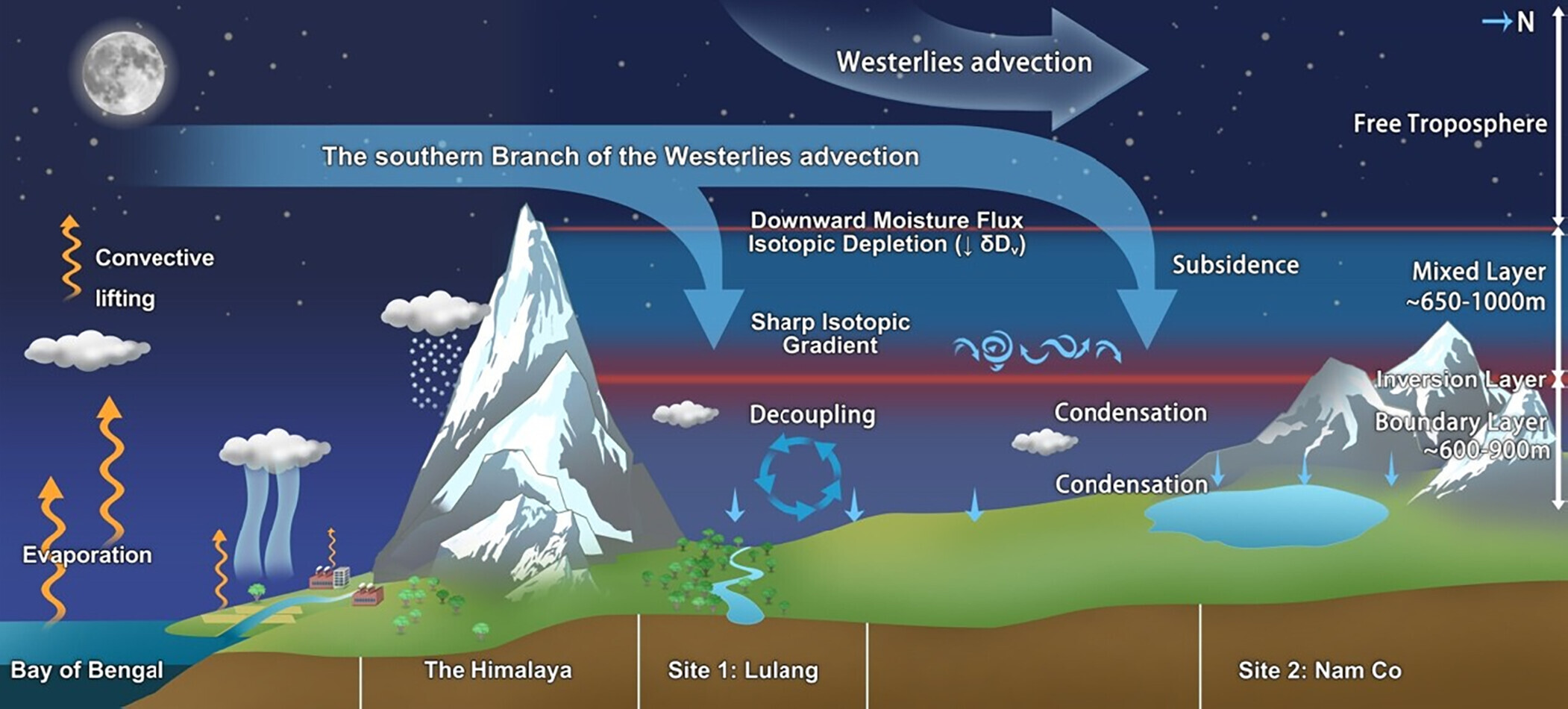
Schematic illustration of the two decoupled conveyor mechanisms driving the vertical integration of moisture advected by the westerlies into the atmospheric water cycle on the AWTs. (Image by GAO Jing)
<関連情報>
- https://english.cas.cn/newsroom/research-news/202605/t20260511_1159110.shtml
- https://www.pnas.org/doi/10.1073/pnas.2529749123
Vertical conveyor driving the integration of moisture transported by the westerlies to the Asian water towers’ atmospheric water cycle
Jing Gao, Tandong Yao , Valérie Masson-Delmotte, +15 , and Maosheng He
Proceedings of the National Academy of Sciences Published:May 6, 2026
DOI:https://doi.org/10.1073/pnas.2529749123
Significance
Recent cryospheric imbalance across the Asian water towers, threatening water security for over two billion people, reflects the coupled effects of large-scale atmospheric circulation and global warming. Disentangling these effects remains challenging due to limited understanding of how moisture advected by the westerlies interacts with local boundary-layer processes. Using three-dimensional observations of atmospheric water vapor isotopes, we trace vertical moisture transport during winter and spring. Combined with modeling, these data reveal a conveyor mechanism that governs vertical moisture transport under calm, westerlies-dominated conditions. Nocturnal subsidence decouples westerlies-advected moisture aloft from residual boundary-layer moisture, locking remote-source vapor into the local water budget. These findings provide key constraints for atmospheric models, climate projections, and interpretations of regional isotope proxy records.
Abstract
The westerlies moisture transport underpins water security for over two billion people dependent on the Asian water towers (AWTs). However, the mechanisms by which large-scale westerlies-advected moisture is integrated into the AWTs’ atmospheric water budget remain poorly understood due to observational gaps. Here, we combine three-dimensional observations of atmospheric water vapor stable isotopes with isotope-enabled modeling. We identify the conveyor mechanism that regulates the vertical moisture transport under calm conditions during the winter-spring period when the westerlies are dominant. Sharp vertical isotopic gradients show that large-scale westerlies-advected moisture is predominantly confined aloft, while local residual moisture persists near the surface. Our results show the interplay of the westerlies’ subsidence at night with thermodynamically distinct local residual air, yielding thermal inversions and condensation that suppresses vertical mixing and decouples moisture between the free troposphere and the atmospheric boundary layer. This process constitutes a primary pathway for integrating westerlies-advected moisture into the local moisture budget without precipitation, sustaining near-surface moisture accumulation. Our results provide critical benchmarks for improving atmospheric models, refining climate projections of the intensifying water cycle over the AWTs, and advancing interpretations of isotopic records in regional climatic archives.