2026-06-11 スタンフォード大学
<関連情報>
- https://news.stanford.edu/stories/2026/06/rice-fish-farming-tropical-disease-schistosomiasis-research
- https://www.nature.com/articles/s41893-026-01833-8
稲作と養魚の混養は、住血吸虫症のリスクを低減し、収量と収入を増加させる Rice–fish co-culturing reduces schistosomiasis risk and increases yields and incomes
Emily K. Selland,Nicolas Jouanard,Amadou Guisse,Momy Seck,Andrea J. Lund,David López-Carr,Alexandra Sack,Louis Dossou Magblenou,Giulio A. De Leo,Molly J. Doruska,Christopher B. Barrett & Jason R. Rohr
Nature Sustainability Published:11 May 2026
DOI:https://doi.org/10.1038/s41893-026-01833-8
Abstract
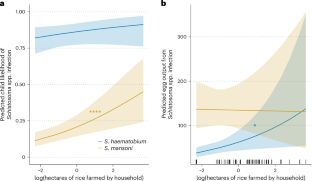
Over 140 million households cultivate rice worldwide. However, rice production contributes to exceedance of planetary boundaries, such as freshwater use and biogeochemical flows. In addition, rice-farming families may face increased risk of contracting schistosomiasis, a parasitic disease transmitted by freshwater snails that contributes to reinforcing cycles of poverty and disease. Here, using data from 405 households in rural northern Senegal, we show that children in rice-farming households had higher Schistosoma mansoni prevalence and Schistosoma haematobium intensities than non-farming peers. To address this environmental health challenge, we integrated native Nile tilapia (Oreochromis niloticus) and African bonytongue (Heterotis niloticus) into rice fields. The fish thrived, suppressed insects and snail pests, improved soil nutrients and boosted rice yields by >25% with a net benefit of US$1,805–3,415 ha−1 yr−1 (a benefit-to-cost ratio of 7.42). Hence, low-input rice–fish co-culturing offers a sustainable planetary health solution that simultaneously improves agricultural outcomes and rural livelihoods while reducing disease transmission risks.