2026-07-07 マサチューセッツ大学アマースト校
<関連情報>
- https://www.umass.edu/news/article/theyre-here-biologists-identify-first-established-colonies-invasive-clam-northeastern
- https://link.springer.com/article/10.1007/s10530-026-03861-z
北半球での旅を終える:アサリ(学名: Ruditapes philippinarum)(二枚貝綱:マルスズメダイ科)が北大西洋北西部にたどり着く Completing the journey in the global north: the Manila clam (Ruditapes philippinarum) (Bivalvia: Veneridae) arrives in the Northwest Atlantic Ocean
Alysha B. Putnam,Carolina Bastidas,Owen C. Nichols,Jeff C. Clements,El Fernekees Hartshorn,Diana W. Chin,Alison Frye,Renee Gagne,Megan Lynn Geiger,Rachel Hutchinson,Vania Rivera Leon,Alexis J. Neffinger,Joshua Reitsma,Tommy Tucker,Isabella C. Yeung & James T. Carlton
Biological Invasions Published:04 July 2026
DOI:https://doi.org/10.1007/s10530-026-03861-z
Abstract
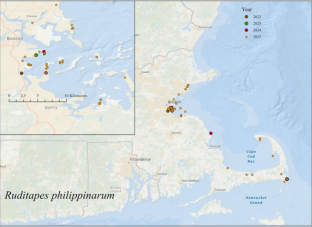
The Manila clam, Ruditapes philippinarum, is one of the world’s most widely introduced marine bivalves, but its establishment has not yet been documented in the Northwest Atlantic Ocean. Here we report the first records of reproducing populations of R. philippinarum from Massachusetts, U.S.A. Observations were collected through opportunistic field surveys, community science platforms (i.e., iNaturalist), and correspondence and discussions with commercial and recreational shellfish harvesters. These observations revealed the presence of R. philippinarum at multiple locations in Cape Cod and Boston Harbor between 2023 and 2025, with northernmost occurrences now reaching Salem Sound, north of Boston. Live individuals from Cape Cod ranged from 31 to 71 mm in shell length (SL). Similar size ranges were documented in Boston Harbor, with additional targeted sediment sampling documenting early settlers (500 µm SL) and young juveniles (1–7 mm SL), confirming this species to be established and reproducing. Community science contributions and engagement with shellfishers expanded the known distribution of R. philippinarum and prompted additional search efforts in 2025, highlighting the importance of broad community engagement in early detection. Further work is needed to determine the potential source population, understand the species’ role in Northwest Atlantic ecosystems, and track its potential spread.