2026-06-09 中国科学院(CAS)
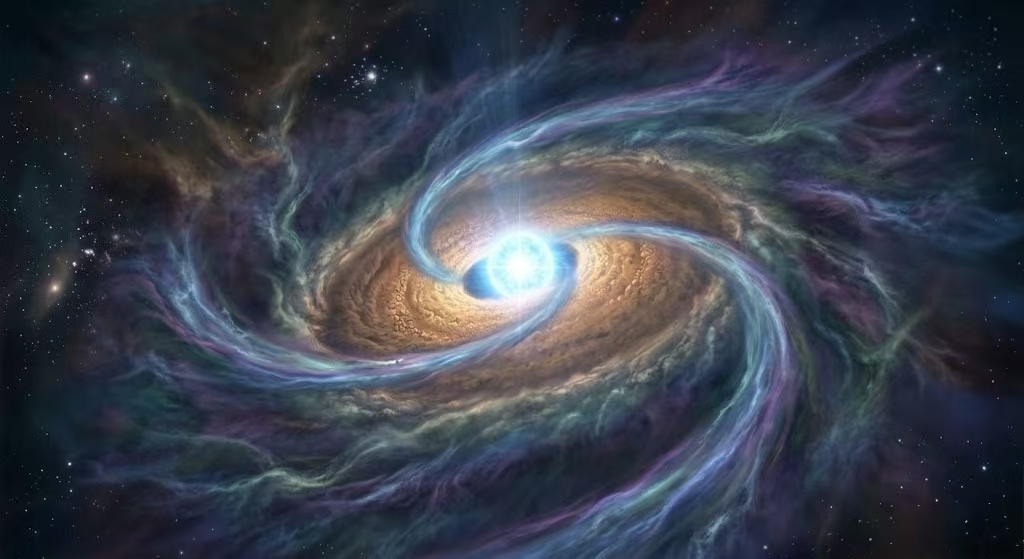
An artist’s impression of the accretion disk, envelopen, and streamers surrounding the massive protostar G359.44-0.102. (Image by SHAO)
<関連情報>
- https://english.cas.cn/newsroom/research-news/202606/t20260609_1161417.shtml
- https://iopscience.iop.org/article/10.3847/1538-4357/ae6813
中心分子帯のいて座C雲にある初期O型原始星を取り囲むケプラー円盤、エンベロープ、およびストリーマー The Keplerian Disk, Envelope, and Streamers Surrounding an Early O-type Protostar in the Sagittarius C Cloud of the Central Molecular Zone
Jixiang Weng (翁吉祥), Xing Lu (吕行), Yu Cheng (程宇), Hongping Deng (邓洪平), Xiaofeng Mai (麦晓枫), Suinan Zhang (张遂楠), Cara Battersby, Adam Ginsburg, Elisabeth A. C. Mills, Yichen Zhang,…
The Astrophysical Journal Published: 2026 May 28
DOI:10.3847/1538-4357/ae6813
Abstract
Disk-mediated accretion is central to theories of massive star formation, setting the initial conditions for their evolution. Yet observations of Keplerian disks around early O-type protostars remain scarce, as they are often blended into complex surrounding structures. We report Atacama Large Millimeter/submillimeter Array Band 6 observations (300 au resolution) of an accretion disk surrounding a high-mass protostar in the Sagittarius C cloud in the Central Molecular Zone (CMZ) around the Galactic center. We identify spectral lines and analyze the spatial distribution of the emission of the complex organic molecules. We use a dynamical model with an inner Keplerian disk and an outer free-fall envelope to fit the three-dimensional position–position–velocity data of the stacked CH3OCHO molecular lines and constrain the mass of the central protostar to be∼40+2–3 M⊙ . The fitting results additionally show that the disk has a centrifugal radius at about 1300 au. Considering the infall velocity, radius, and mass of the envelope, we estimate the accretion rate from the envelope onto the disk to be ∼7 × 10⁻³ M⊙ yr−1. We also identify spiral-like structures in the disk that can be described by free-falling streamers. Our results highlight the critical role of accretion disks and streamers in the mass accumulation of early O-type stars in the CMZ.