2026-04-22 中国科学院(CAS)
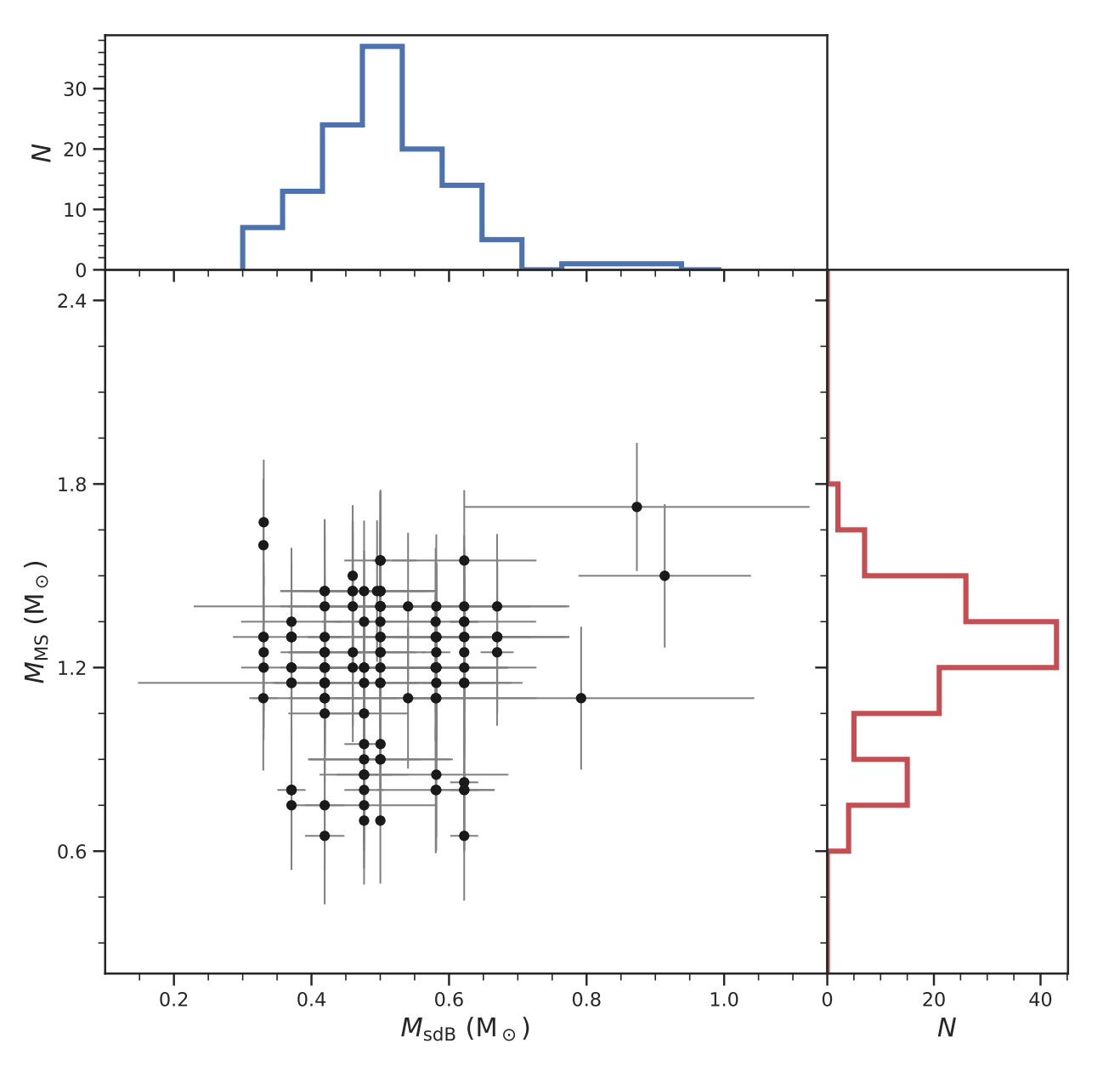
Two-dimensional distribution of stellar masses for the sdB and MS components in our sample of 123 composite-spectrum binaries. The x-axis shows the sdB mass and the y-axis shows the MS companion mass, both in solar masses. (Image by LI Jiangdan)
<関連情報>
- https://english.cas.cn/newsroom/research-news/202605/t20260508_1158615.shtml
- https://iopscience.iop.org/article/10.3847/1538-4357/ae5221
LAMOSTによる複合スペクトル準矮星+主系列星連星の恒星パラメータと軌道周期の推定 Stellar Parameters and Orbital Period Estimates for Composite-spectrum Subdwarf + Main-sequence Binaries from LAMOST
Jiangdan Li, Jianping Xiong, Jiao Li, Hai-Liang Chen, Hongwei Ge, Mingkuan Yang, Xuefei Chen, and Zhanwen Han
The Astrophysical Journal Published: 2026 April 2
DOI:10.3847/1538-4357/ae5221
Abstract
Hot subdwarf (sdB) stars in binary systems with main-sequence (MS) companions provide valuable insights into mass transfer and envelope ejection processes in binary evolution. Their mass ratios, orbital periods, and stellar properties encode key information about their evolutionary histories. In this work, we analyze a sample of 123 composite-spectrum sdB+MS binaries identified from the Large Sky Area Multi-Object Fiber Spectroscopic Telescope Low-Resolution Survey (LAMOST-LRS) Data Release (DR) 8. We adopt atmospheric parameters from spectral decomposition and estimate stellar masses and radii using theoretical evolutionary tracks. Radial velocities for both the sdBs and cool companions are measured independently through cross correlation with synthetic templates. Orbital periods are statistically estimated using single-epoch radial velocity separations and a Monte Carlo method that accounts for random inclination and orbital phase. We find that sdB masses are narrowly distributed around 0.5 M⊙, consistent with expectations for core-helium-burning stars, while MS companion masses span 0.6–1.9 M⊙, with most falling between 1.0 and 1.4 M⊙. The inferred orbital-period distribution shows a clear concentration toward long periods, broadly consistent with expectations for binaries formed through stable Roche-lobe overflow. Given that our sample consists of composite-spectrum sdB binaries, mainly sdB+FGK systems, the prevalence of long periods is largely driven by observational selection effects rather than the intrinsic period distribution of the sdB binary population. This study provides one of the largest uniform catalogs of composite spectrum sdB binaries to date, offering new observational constraints on their physical properties and formation channels.