2026-04-22 中国科学院(CAS)
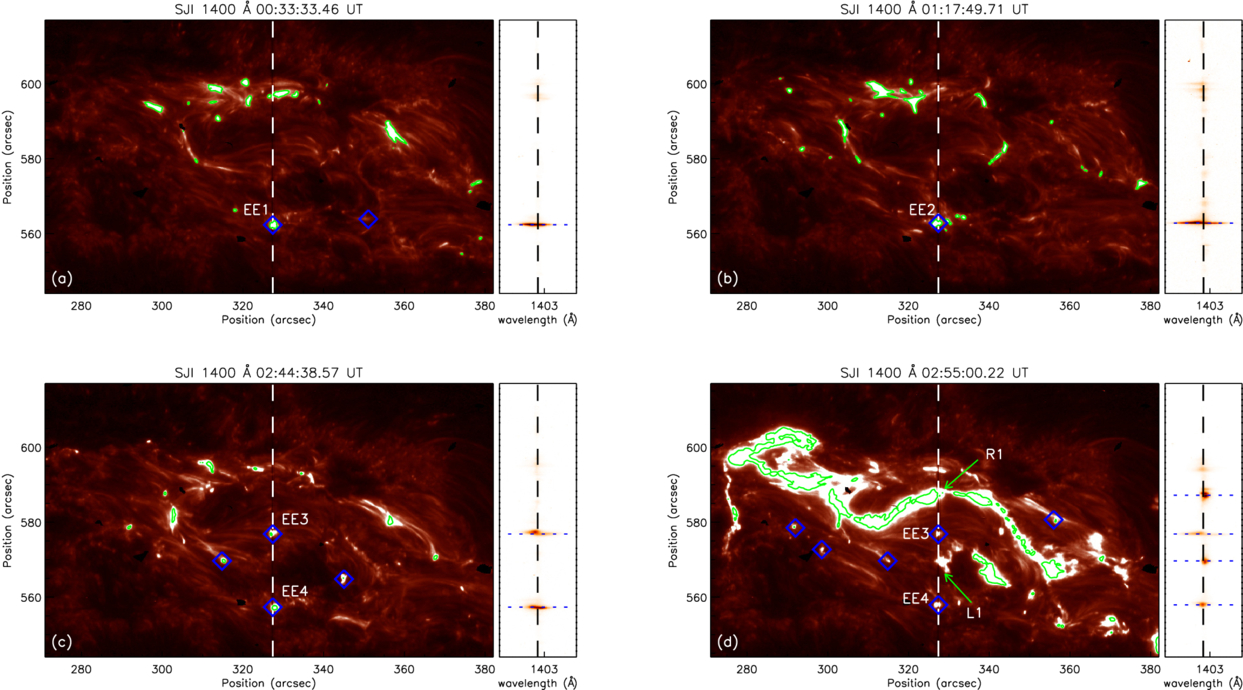
Overview of TR EEs in NOAA AR 13213, observed with IRIS SJIs at 1400 Å and the corresponding Si iv 1403 Å spectra near 00:33:33 UT, 01:17:50 UT, 02:44:39 UT, and 02:55:00 UT. In each SJI panel, the vertical white dashed line indicates the slit position. EE1–EE4 and the blue diamond denote the locations of EEs. Green contours outline regions with intensities exceeding 5% of the maximum within the field of view. In the spectral panels, vertical black dashed lines mark the line center of Si iv 1403 Å, while horizontal black dashed lines indicate the positions of EEs, flare ribbons, and loop structures. (Image by ZHOU Yi’an).
<関連情報>
- https://english.cas.cn/newsroom/research-news/202605/t20260508_1158616.shtml
- https://iopscience.iop.org/article/10.3847/1538-4357/ae4c4f
4つの長時間遷移領域爆発事象の分光学的事例研究 Spectroscopic Case Studies of Four Long-duration Transition-region Explosive Events
Yi’an Zhou, Xiaoli Yan, Zhike Xue, Liheng Yang, Jincheng Wang, and Zhe Xu
The Astrophysical Journal Published: 2026 March 24
DOI:10.3847/1538-4357/ae4c4f
Abstract
This work presents a detailed spectroscopic case study of four long-duration transition-region (TR) explosive events (EEs) observed in NOAA Active Region 13213 on 2023 February 10 using the Interface Region Imaging Spectrograph. The dynamic spectral evolution of each event is tracked through multicomponent Gaussian fitting of the Si iv 1403 Å line profiles. Three recurrent spectral morphologies are identified and characterized: bilateral wing enhancement, exclusive red-wing enhancement, and exclusive blue-wing enhancement, among which bilateral enhancement is the most common in the studied cases. Throughout their lifetimes of 20–25 minutes, these events display sustained and evolving bidirectional flows, with high-velocity components (∣v∣ > 100 km s−1) emerging in late phases. These spectral signatures are interpreted as evidence of ongoing or recurrent magnetic reconnection, where bilateral profiles correspond to bidirectional outflows, and exclusive wing enhancements represent geometric or evolutionary phases of the same process. In contrast, cotemporal flare ribbons and loop structures exhibit pronounced, unidirectional redshifts. This study underscores that significant non-Gaussian wing enhancement, rather than exclusively high speed, constitutes a defining spectroscopic signature of EEs, and provides detailed kinematic constraints on the dynamics of such TR EEs.