
2026-04-30 高知大学
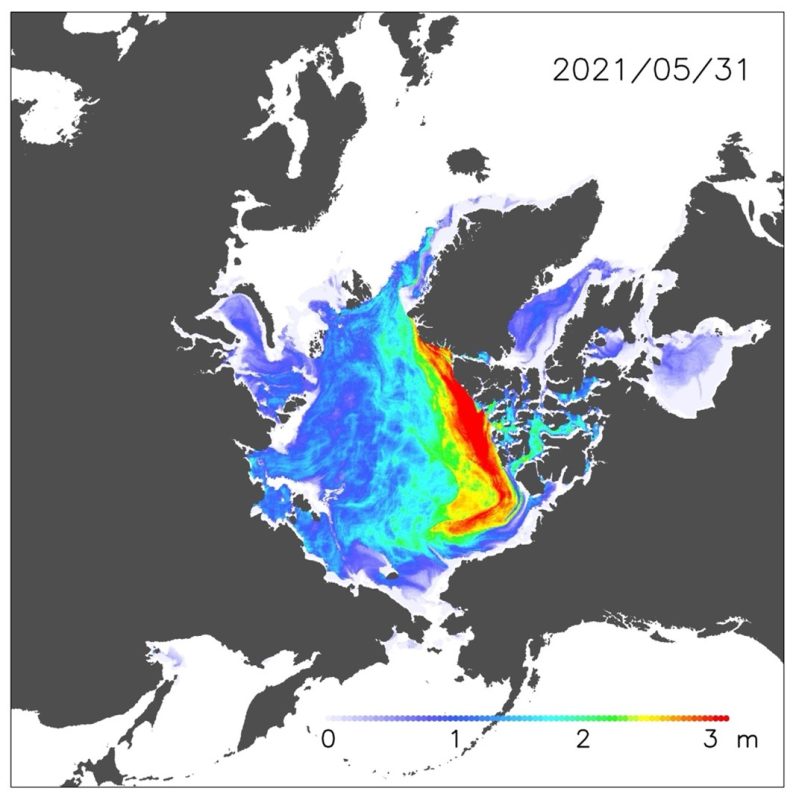
本研究で開発した手法により推定された2021年5月31日の北極海の海氷厚分布。青色は薄い海氷、赤色は厚い海氷を示す。カナダ多島海沖には3メートルを超える厚い海氷が分布しており、それらがアラスカ沖へ流出している様子が確認できる。
<関連情報>
- https://www.kochi-u.ac.jp/news/北極海の海氷の厚さを衛星データから推定する新/
- https://tc.copernicus.org/articles/20/2331/2026/
衛星データに基づく氷の履歴から北極海の海氷厚を推定する Estimating Arctic sea ice thickness from satellite-based ice history
Noriaki Kimura and Hiroyasu Hasumi
The Cryosphere Published:23 Apr 2026
DOI:https://doi.org/10.5194/tc-20-2331-2026
Abstract
A novel method is presented for estimating Arctic sea ice thickness by reconstructing its growth history from satellite-derived ice motion and concentration data, together with meteorological data. Using observations from the Advanced Microwave Scanning Radiometer for EOS (AMSR-E) and AMSR2, virtual sea ice particles were tracked backward in time to determine their formation date and subsequent drift path. Surface heat budget calculations were performed to estimate daily thermodynamic growth at each particle’s location from the time of formation. Sea ice thickness was then obtained by scaling the accumulated thermodynamic growth to match upward-looking sonar (ULS) observations. The estimated ice thickness successfully reproduced the seasonal and interannual variability observed in the in situ data, with an RMS error in the daily-mean thickness of 44.0 and 36.3 cm when compared to ULS observations in the Beaufort Sea and Fram Strait, respectively; larger errors are expected in seasonal ice areas such as the Laptev Sea. These results demonstrate that satellite-derived sea ice histories provide a robust basis for estimating sea ice thickness, opening new possibilities for retrieving difficult-to-observe sea ice properties through reconstructions of their historical evolution.
