2025-12-23 東京科学大学
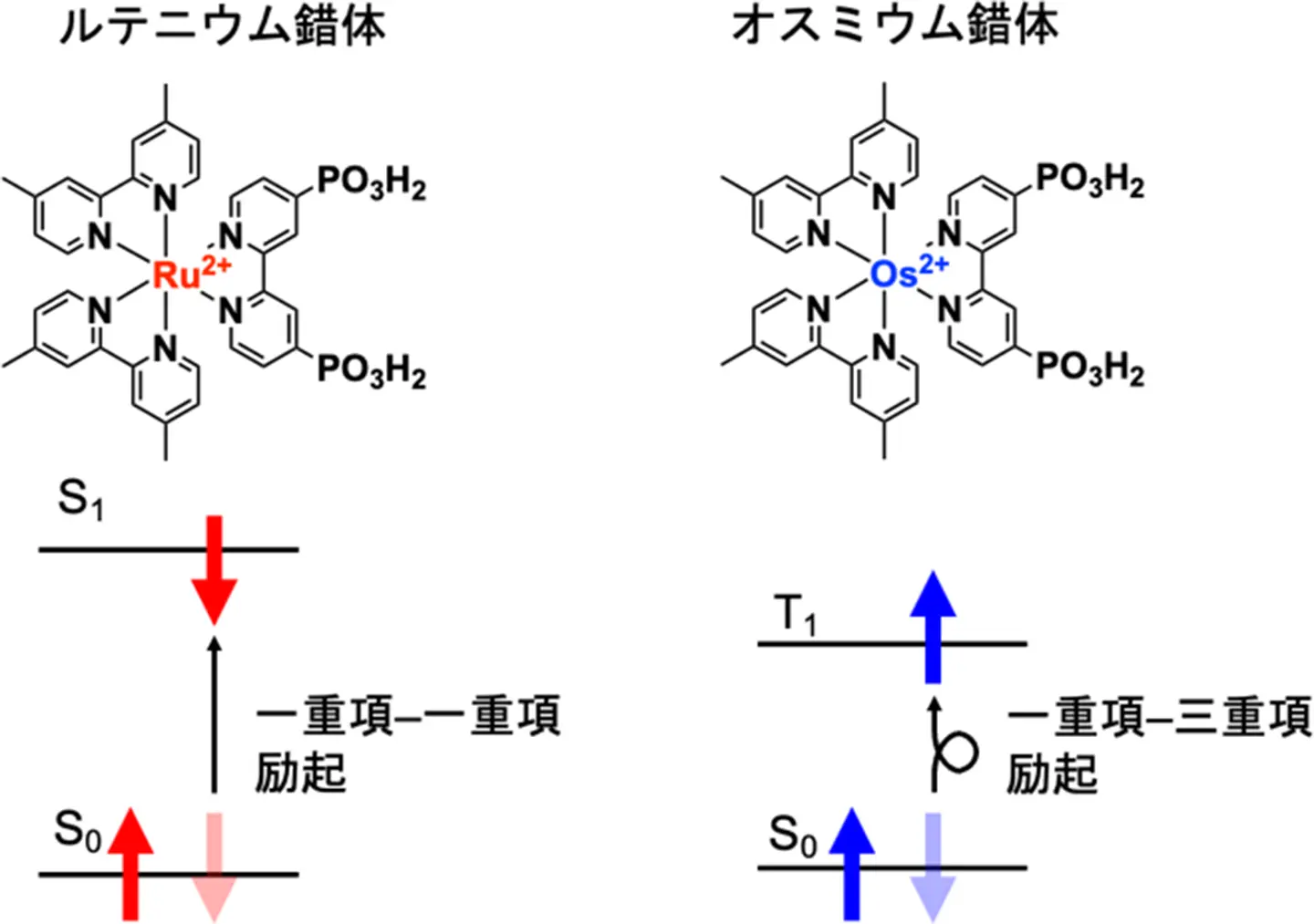
図2. (上)ルテニウム錯体とオスミウム錯体の分子構造と、(下)一重項−一重項遷移と一重項−三重項遷移
<関連情報>
一重項-三重項励起に基づく長波長可視光吸収を有する金属錯体増感剤を用いた色素増感光触媒における電荷移動ダイナミクス Charge Transfer Dynamics in Dye-Sensitized Photocatalysts Using Metal Complex Sensitizers with Long-Wavelength Visible Light Absorption Based on Singlet–Triplet Excitation
Haruka Yamamoto,Toshiya Tanaka,Masahito Oura,Kelly M. Kopera,Megumi Okazaki,Ken Onda,Thomas E. Mallouk,and Kazuhiko Maeda
ACS Catalysis Published: December 5, 2025
DOI:https://doi.org/10.1021/acscatal.5c06687
Abstract
An Os(II) polypyridyl complex was applied as a photosensitizer in dye-sensitized photocatalyst systems based on Pt-intercalated HCa2Nb3O10 and Pt-loaded TiO2. The Os(II) complex exhibits a spin-forbidden but partially allowed triplet metal-to-ligand charge transfer (3MLCT) transition, enabling broad visible light absorption up to 800 nm, which surpasses that of conventional Ru(II)-based dyes. Despite its shorter excited-state lifetime compared to Ru(II) complexes, efficient electron injection from the excited Os(II) dye into the semiconductor was confirmed. Under visible-light irradiation, the Os(II)-sensitized photocatalysts showed higher H2 evolution activity than the Ru(II)-sensitized photocatalysts when sodium ascorbate was used as an electron donor, demonstrating effective utilization of long-wavelength visible light. In contrast, negligible H2 evolution was observed when NaI was employed as a redox mediator for Z-scheme water splitting. Transient absorption spectroscopy revealed that the lack of activity stemmed from inefficient electron transfer from I– to oxidized Os(II). These findings highlight the importance of selecting appropriate redox mediators to fully exploit long-wavelength dyes for overall water splitting under visible light.