026-05-25 中国科学院(CAS)
<関連情報>
- https://english.cas.cn/newsroom/research-news/202605/t20260526_1159911.shtml
- https://academic.oup.com/nsr/article/13/9/nwag245/8662459?login=false
水深測量と地形図作成によって明らかになった中国の淡水湖貯水ホットスポット China’s freshwater lake storage hotspots revealed by bathymetry and typology mapping
Chunqiao Song,Kai Liu Pengfei Zhan,Chenyu Fan,Weilong Yang,Liping Zhu,Bin Xue,Guoqing Zhang,Gang Zhao,Lian Feng,…
National Science Review Published:25 April 2026
DOI:https://doi.org/10.1093/nsr/nwag245
ABSTRACT
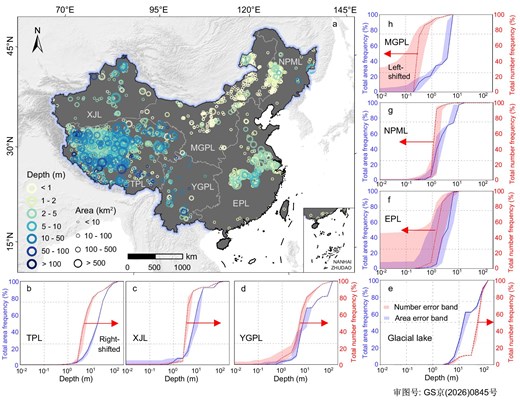
A nation’s freshwater security is fundamentally constrained by the total volume and spatial distribution of its water resources, yet this first-order information remains remarkably uncertain at large scales. For China, home to one-fifth of the world’s population but only 7% of its total renewable freshwater resources, this knowledge gap is particularly critical. While decades of satellite observations have tracked changes in lake surface area and water level, the total storage volume of the nation’s lakes have remained unknown, precluding a robust assessment of its water security. Here, we present the first national-scale bathymetric and typologic assessment of all natural lakes in China larger than 1 km². We reveal a total lake water volume of ∼1174 km³ (uncertainty range: 1081–1285 km³), comprising ∼335 km³ of freshwater and ∼839 km³ of saline water. While the western interior is numerically dominated by saline lakes, our volumetric assessment reveals a counterintuitive pattern in which a few large open lakes store ∼65% of the nation’s lacustrine freshwater due to their exceptional depth. The freshwater lake hotspots present a marked geographic–demographic contrast. This imbalance results in a more significant disparity in per-capita natural lake freshwater storage, with ∼20 680 m³ per person in the Tibetan Plateau lake zone versus only 65 m³ in the eastern plain lake zone, a nearly 320-fold difference. Notably, a vast network of reservoirs is concentrated in the populous eastern region, and this distribution of artificial storage helps mitigate the spatial unevenness of total surface freshwater resources. Our findings not only establish a definitive baseline for China’s lake water resources but also demonstrate how lakebed geomorphologic features influence national-scale lacustrine freshwater distribution, highlighting the critical need for targeted protection strategies and the efficient utilization of these lake freshwater reserves.