2025-11-11 国立情報学研究所
<関連情報>
- https://www.nii.ac.jp/news/2025/1111.html
- https://connect.geant.org/2025/10/27/fast-redundant-resilient-iter-japan-proves-the-power-of-aer-at-100-gbps
高速、冗長性、耐障害性:ITER-Japanが100GbpsのAERの威力を実証
Fast, Redundant, Resilient: ITER–Japan Proves the Power of AER at 100 Gbps
24 Oct 2025 (updated) – Recently, the ITER project and the Broader Approach’s QST network teams carried out a series of high-speed data transfer tests between the ITER Marseille Data Transfer Node (DTN) and the JA REC facility in Japan, from mid-August to early September 2025. The tests were supported by members of the Asia-Pacific Europe Ring (AER) partner network (aer-network.net), whose multiple international 100 Gbps links connect Europe, Asia, and the Pacific in a resilient ring topology.
The objective was to validate throughput close to the 100 Gbps link capacity, test sustained performance, evaluate multi-path capabilities, and identify bottlenecks—critical preparation ahead of ITER’s operational phase in 2034, when petabytes of experimental data will need to be transferred globally in near real-time.
The tests built upon the important infrastructure improvements realized over the past few years. REC, via SINET, increased its connectivity to Amsterdam, Europe to 100 Gbps. At the same time, ITER constructed its data dissemination network node in Marseille, opening the way to external connectivity of 100 Gbps via their providers RENATER and GÉANT. Therefore, the conditions were ripe to conduct a trans-continental 100 Gbps end-to-end test. Specifically for this test, the capacity has been doubled with a second independent 100 Gbps Singapore link, which could be used to split the load or to serve as a reserve capacity in the case of primary link failure.
In this test-run, multiple protocols were evaluated:
- ITER.Sync, a parallel rsync-based tool
- Fast Data Transfer (FDT)
- Massively Multi-Connection File Transfer Protocol (MMCFTP)
These tests consisted of two coordinated campaigns: one led by ITER using the ITER.Sync parallel rsync tool, and another led by QST using MMCFTP and FDT. Both aimed to validate end-to-end 100 Gbps transfers across the AER network under realistic operational conditions. The combination of these campaigns provided complementary insights — ITER.Sync representing practical, multi-file transfers for operational workflows, and MMCFTP/FDT demonstrating theoretical link saturation in controlled scenarios.
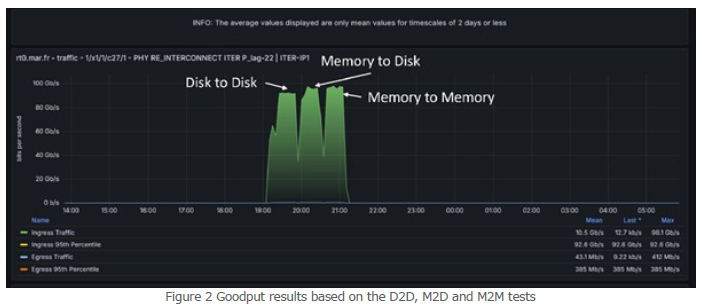
The tools demonstrated comparable results, ranging from 55 to 90 Gbps sustained, depending on network utilization strategy (collaborative versus exclusive), data set assembly approach, or simply due to daily variations in network load. With MMCFTP on tailored data sets in exclusive mode, the speed was peaking up to 91 Gbps for useful payload, demonstrating full 100 Gbps channel utilization.
In the current DT-1 scenarios, the pulses of ITER could generate, on average, 20 TB of data per hour of operation. It was demonstrated that these data could be transferred to the remote site within the hour with a good margin, which would be required for non-stop experiment campaigns.
For long transfers, routine throughput of 500 TB per day was demonstrated using the ITER.Sync tool, practically limited by the currently available data transfer nodes. Separate runs indicate that with production-level nodes, performance would scale linearly. In one test, multiple 176 TB file sets — comprising 327,000 individual files — were transferred in just under eight hours.
Finally, transfers via two physical paths in parallel were also demonstrated, using either independent pairs of sender-receiver, or employing lower-level balancing via ECMP protocol. This feature would be essential in real-life operating scenarios, both for resilience to failures and from the point of view of collaborative use of scientific backbone networks. Figure 1 shows the test timeline with transfers approaching the full 100 Gbps bandwidth.
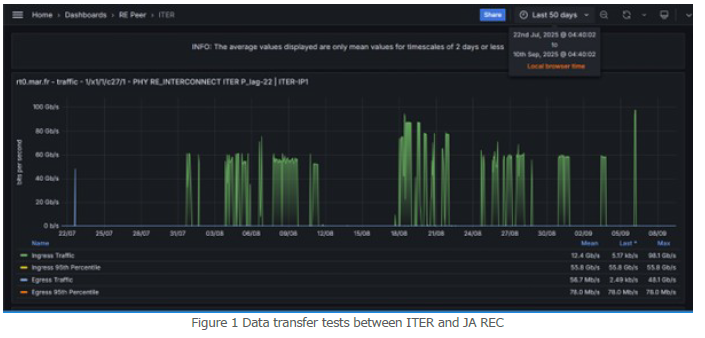
Figure 2 captured MMCFTP speed test results using different data transfer modes: Disk to Disk (D2D), Memory to Disk (M2D) and Memory to Memory (M2M), aiming to demonstrate full bandwidth utilization.