2025-11-05 ユニバーシティ・カレッジ・ロンドン(UCL)
<関連情報>
- https://www.ucl.ac.uk/news/2025/nov/ageing-stars-may-be-destroying-their-closest-planets
- https://academic.oup.com/mnras/article/544/1/1186/8286899?login=false
主系列以降の恒星進化がトランジット巨大惑星集団に与える影響の解明 Determining the impact of post-main-sequence stellar evolution on the transiting giant planet population
Edward M Bryant, Vincent Van Eylen
Monthly Notices of the Royal Astronomical Society Published:15 October 2025
DOI:https://doi.org/10.1093/mnras/staf1771
ABSTRACT
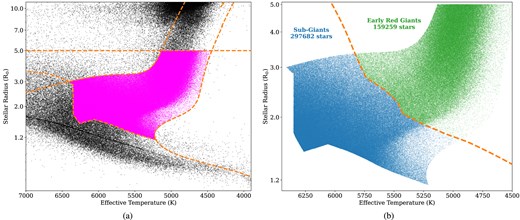
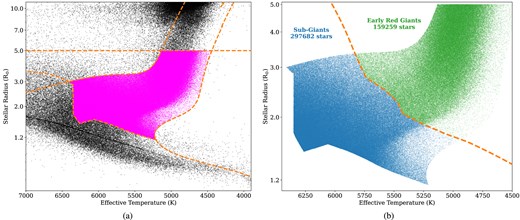
The post-main-sequence evolution of stars is expected to impact the exoplanets residing on close-in orbits around them. Using photometric data from the Transiting Exoplanet Survey Satellite full-frame images we have performed a transit search for exoplanets with post-main-sequence hosts to search for the imprints of these impacts on the giant planet population. We detect 130 short-period planets and candidates, 33 of which are newly discovered candidates, from a sample of 456 941 post-main-sequence stars spanning the evolutionary stages from the end of the main sequence to the bottom of the red giant branch. We measure an occurrence rate of 0.28±0.04 per cent for short-period giant planets orbiting post-main-sequence stars. We also measure occurrence rates for two stellar sub-populations, measuring values of 0.35±0.05 per cent for a sub-population representing the earliest stages of post-main-sequence evolution and 0.11+0.06-0.05 per cent for a sub-population of more evolved stars. We show that the giant planet occurrence rate decreases with increasing stellar evolution stage, with a larger occurrence rate decrease observed for shorter period planets. Our results are clear evidence that the population of short-period giant planets is being sculpted by the post-main-sequence evolution of the host stars, and we conclude that this is most likely through the destruction of these giant planets through the increased strength of planet–star tidal interactions resulting in the rapid tidal decay of the planets’ orbits.