2025-11-10 カリフォルニア大学アーバイン校
<関連情報>
- https://news.uci.edu/2025/11/10/uc-irvine-team-track-massive-ice-loss-from-berry-glacier-in-west-antarctica/
- https://www.nature.com/articles/s41467-025-64330-0
西南極のベリー氷河の急速な後退は、レーダー干渉計によって明らかにされた海水侵入に関連している Rapid retreat of Berry Glacier, West Antarctica, linked to seawater intrusions revealed by radar interferometry
Hanning Chen,Eric Rignot,Bernd Scheuchl,Pietro Milillo,Mathieu Morlighem,Ratnakar Gadi,Enrico Ciracì,Jae Hun Kim & Luigi Dini
Nature Communications Published:21 October 2025
DOI:https://doi.org/10.1038/s41467-025-64330-0
Abstract
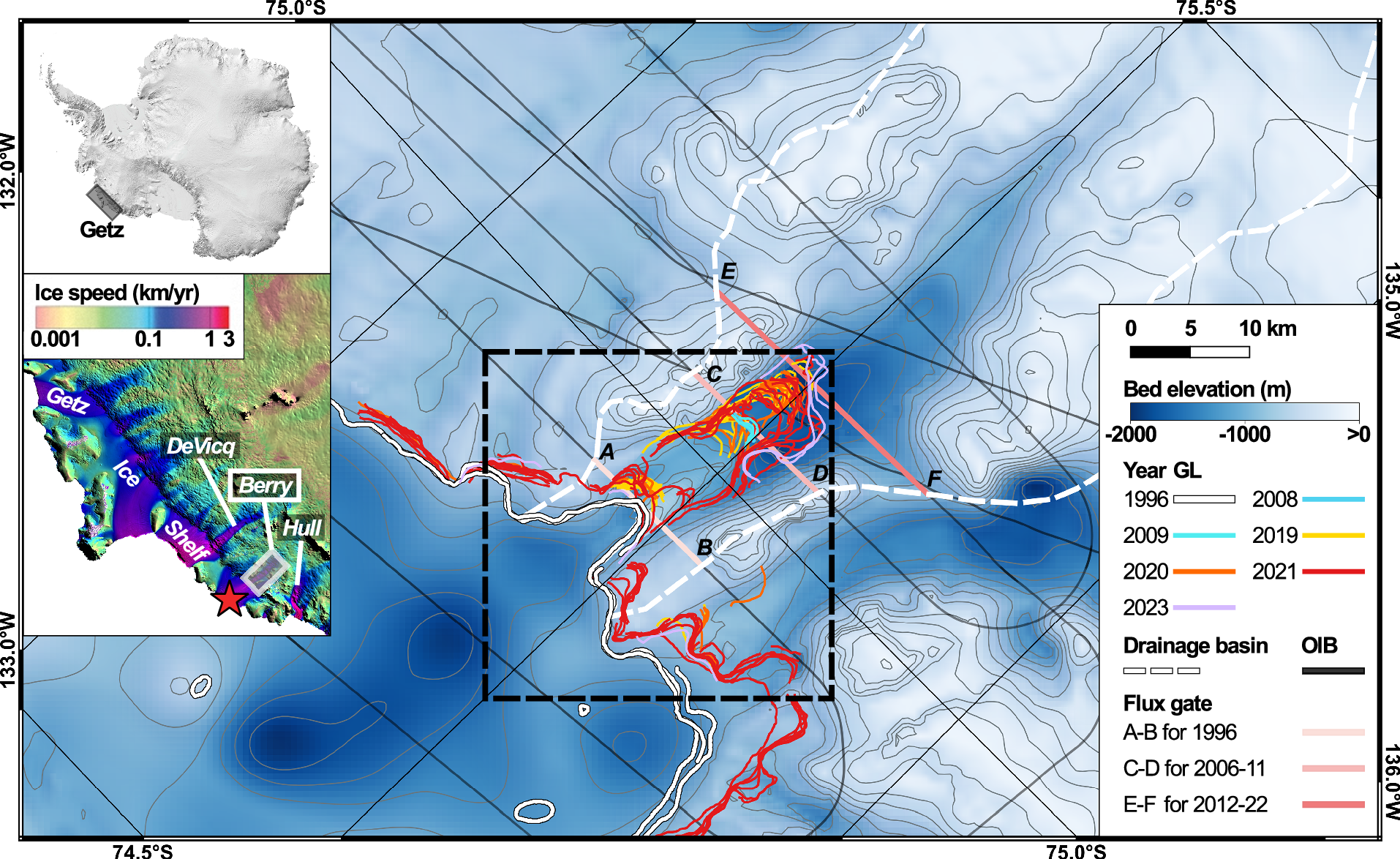
We employ a time series of ERS-1/2, ALOS-1/2 PALSAR, Sentinel-1, COSMO-SkyMed, and RCM differential synthetic-aperture radar interferometry data from 1996 to 2023 to document the short and long-term migrations of the grounding line (GL) of Berry Glacier, West Antarctica, a tributary of Getz Ice Shelf that controls 10% of its ice discharge. In 2019–2021, we detected a short-term GL migration of 18.0 ± 0.9 km, which is exceptionally long and implies that the glacier bed is up to 1300 m deeper than previously known. On short time scales, the GL migrates between three states controlled by bed topography. The observed flexing of the glacier suggests that seawater is trapped in the newly formed ice shelf cavity in an irregular fashion during the tidal cycle. From 1996 to 2021, the most inland position of the GL retreated by 18.1 ± 0.4 km, or 0.7 km/year, the ice thickness decreased by 11 ± 1 m/year, the ice sped up by 64 ± 5%, and the glacier lost a total mass of 131 ± 23 Gt. We attribute the rapid retreat to an enhanced ocean heat flux from warm Circumpolar Deep Water (CDW) reaching the grounding line through favorable bathymetry channels, combined with km-sized seawater intrusions beneath the glacier that cause rapid melting of basal ice.