2026-11-02 ワシントン大学(UW)
<関連情報>
- https://www.washington.edu/news/2026/11/02/whole-earth-simulation-exoplanets-alien-life/
- https://iopscience.iop.org/article/10.3847/PSJ/ae9d79
地球型系外惑星研究のための、生命のない地球の全惑星モデル A Whole-planet Model of the Earth without Life for Terrestrial Exoplanet Studies
Samantha Gilbert-Janizek, Rory K. Barnes, Peter E. Driscoll, Nicholas F. Wogan, Avi M. Mandell, Jessica L. Birky, Ludmila Carone and Rodolfo Garcia
The Planetary Science Journal Published: 2026 September 18
DOI:10.3847/PSJ/ae9d79
Abstract
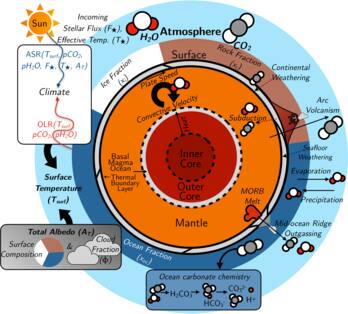
As the only known habitable (and inhabited) planet in the Universe, Earth informs our search for life elsewhere. Future telescopes like the Habitable Worlds Observatory (HWO) will soon look for life on rocky worlds around Sun-like stars, so it is critical that we understand how to distinguish habitable planets from inhabited planets. However, it remains unknown if life is necessary to maintain a habitable planet, or how all of the components of an evolving planet impact habitability over time. As a first step toward answering these questions, we present a coupled interior-atmosphere evolution model of the Earth without life from 50 Myr to 5 Gyr that reproduces 19 key observations of the preindustrial Earth after 4.5 Gyr within estimated measurement uncertainties. We also produce a reflected-light spectrum covering the possible wavelength range of HWO. Our findings suggest that life may not be required to maintain long-term habitable surface conditions. The model presented here is apt for predicting the long-term habitability of Earth-like exoplanets by coupling the interior and surface evolution. By generating realistic reflected-light spectra from evolved atmospheric states, this model represents significant progress towards characterizing the observability of whole-planet evolution, which may ultimately provide a robust abiotic baseline for interpreting biosignature observations with HWO.