2026-10-29 合肥物質科学研究院(HFIPS)
中国科学院合肥物質科学研究院の研究チームは、異なる人工衛星の観測データから、大気中のエアロゾル特性を追加学習なしで一貫して推定できる新手法を開発した。本手法は、高分5号02星(GF-5(02))と大気1号星(DQ-1)に搭載された高精度偏光走査装置の観測データを利用し、衛星観測値と物理法則を組み合わせた物理誘導型の解析手法を採用している。大気中のエアロゾル量、粒子径、光吸収特性などを複数同時に推定でき、GF-5(02)のデータで構築した手法を、追加学習なしでDQ-1にも適用できる。地上観測網AERONETとの比較でも良好な一致を確認した。さらに、世界の陸域を対象とする衛星別および統合型のエアロゾルデータセットを作成した。気候変動に伴うエアロゾルの長期変化や気候への影響の解明、異なる衛星観測データの相互利用に貢献する成果である。
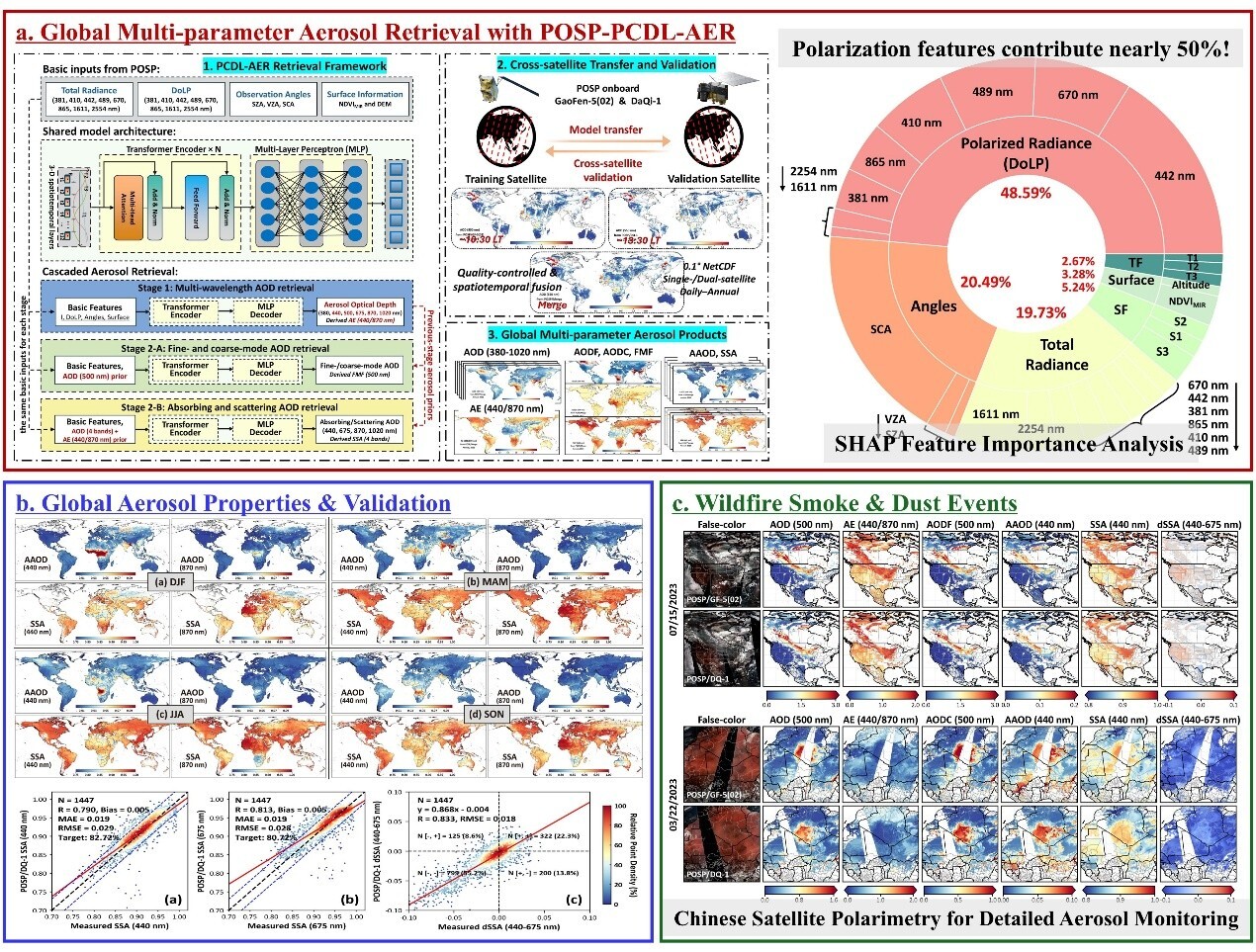
Polarimetric remote sensing from Chinese satellites enables detailed characterization of global aerosol properties. (Image by CHEN Cheng)
<関連情報>
- https://english.hf.cas.cn/nr/rn/202610/t20261029_1212836.html
- https://www.sciencedirect.com/science/article/pii/S0034425726004554
物理法則に基づいた深層学習によって可能になった、2衛星偏光観測からの光学的に整合性のある多パラメータエアロゾル抽出 Optically consistent multi-parameter aerosol retrieval from dual-satellite polarimetric observations enabled by physics-guided deep learning
Zhihui Wang,Cheng Chen,Jing Wei,Xuefeng Lei,Zhenhai Liu,Li Fang,Hui Chen,Pengfei Ma,Yulong Fan,Lin Sun,Changqing Lin,Ke Xiao,Haixiao Yu,Shangpei Xun,Zhengqiang Li,Jin Hong
Remote Sensing of Environment Available online: 21 September 2026
DOI:https://doi.org/10.1016/j.rse.2026.115685
Highlights
- A physics-guided learning approach enables optically consistent multi-parameter aerosol retrieval from dual-satellite polarimetry.
- Joint retrieval of aerosol optical, size-related, and absorption properties is achieved across multiple wavelengths while preserving optical consistency.
- Cross-satellite transferability is achieved without retraining, supporting consistent aerosol monitoring across platforms.
- Dual-satellite aerosol products reveal global, seasonal, and extreme-event variability in aerosol size and absorption.
Abstract
Polarimetric observations provide complementary constraints on aerosol size and absorption, offering enhanced sensitivity for characterizing aerosol variability and its impacts on climate, environment, and human health. The Particulate Observing Scanning Polarimeter (POSP), deployed aboard the GaoFen-5(02) and DaQi-1 satellites, is a multispectral (from ultraviolet to shortwave infrared) cross-track scanning polarimeter to deliver twice-daily global surface-atmosphere observations. Despite the growing use of artificial intelligence for aerosol retrieval from high-dimensional satellite measurements, most existing approaches retrieve aerosol parameters independently, without explicitly enforcing the internal relationships among aerosol optical quantities. In this study, we present a physics-guided learning approach for optically consistent multi-parameter aerosol retrieval from dual-satellite polarimetric observations. The method jointly retrieves primary aerosol optical quantities, including multi-wavelength aerosol optical depth (AOD), fine- and coarse-mode AOD, and absorbing and scattering AOD, and derives secondary parameters such as Ångström exponent (AE), fine-mode fraction (FMF), and single scattering albedo (SSA) from these primary quantities. Importantly, the proposed approach supports direct cross-satellite transfer between POSP-equipped platforms (GF-5(02) and DQ-1), allowing consistent aerosol retrievals to be applied across different satellites without retraining. Validation against ground-based AERONET measurements demonstrates high accuracy for POSP multi-wavelength AOD, with correlation coefficients (R) ranging from 0.93 to 0.96 and root mean square errors (RMSE) between 0.046 and 0.085. Independent cross-satellite evaluations further confirm the robustness and transferability of the retrieval framework under completely independent observational conditions, yielding R values of 0.89–0.95 and RMSE values of 0.054–0.107 across different wavelengths. Retrievals of aerosol size- and absorption-related parameters also show good agreement with AERONET products. The resulting dual-satellite POSP aerosol products are used to characterize global and seasonal variations in aerosol size and absorption during 2023, and to construct multi-year absorption aerosol optical depth (AAOD) time series from November 2021 to December 2023. Applications to extreme aerosol events, including the Canadian wildfires, further highlight the unique value of polarimetric observations for capturing aerosol size and absorption evolution, demonstrating the potential of the proposed approach for advancing aerosol monitoring and environmental applications.