2026-10-16 東京大学
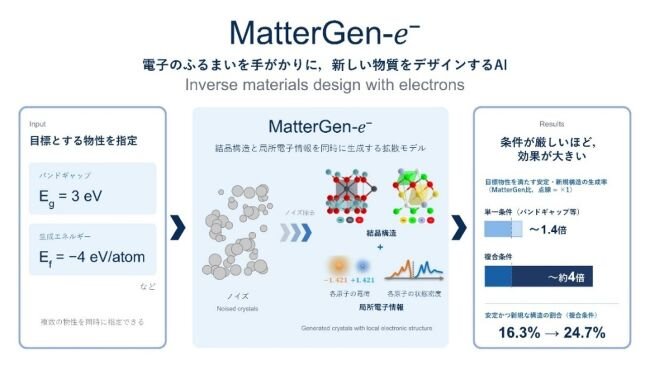
本研究で開発されたMatterGen-e⁻の概要。結晶構造と局所電子情報を同時に生成することで、目標物性を満たす安定・新規な構造の生成率が向上する。
<関連情報>
結晶構造と局所電子記述子の同時生成による逆材料設計 Inverse materials design via joint generation of crystal structures and local electronic descriptors
Ibuki Okuda, Izumi Takahara & Teruyasu Mizoguchi
npj Computational Materials Published:15 October 2026
DOI:https://doi.org/10.1038/s41524-026-02322-4
Abstract
Inverse design of inorganic crystals, in which structures are generated to satisfy a target property while preserving diversity and physical plausibility, remains more demanding than ab initio generation, as property conditioning can degrade the structural quality that current generative models otherwise achieve. We propose a diffusion framework that jointly denoises crystal-structure variables and site-resolved local electronic descriptors through a shared score network. As representative descriptors, we adopt Bader charge and atomic density of states (atomic DOS). Under band-gap- and formation-energy-conditioned generation, as well as their simultaneous combination, the joint models achieve higher success rates than the structure-only baseline in most target conditions, while also increasing the fraction of generated structures that satisfy uniqueness, novelty, thermodynamic stability, and physical validity. Control experiments with noise-corrupted Bader charges and with a physically uninformative dummy variable show that these gains require the jointly generated variable to faithfully reflect the true local electronic structure. The generated Bader charges agree with DFT references with an MAE of 5.4 × 10⁻²e on stable, unique and novel structures, and the generated atomic DOS captures the coarse spectral profile of the DFT reference around the median of its accuracy distribution, although finer details and accuracy vary with elemental species. These results establish local electronic descriptors as effective generative variables that serve two complementary roles: broadening the explored materials space through increased structural diversity, and mitigating the trade-off between property targeting and structural quality by guiding the structural trajectory toward electronically plausible configurations during joint denoising.