2026-10-19 東京農工大学
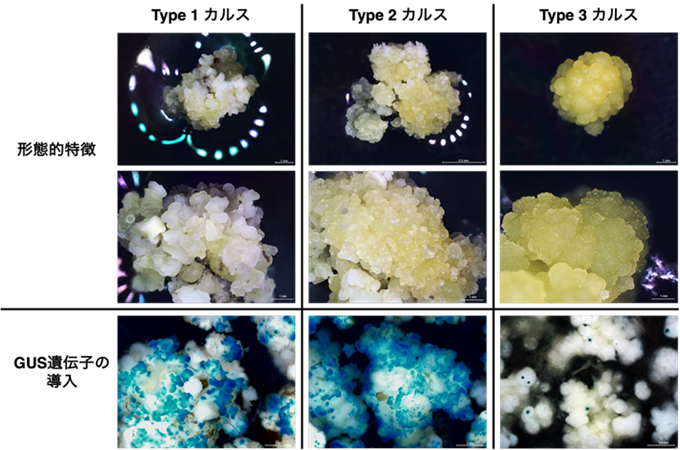
図1:形質転換に適したタイヌビエのカルスの特徴
Type 1およびType 2カルスが遺伝子導入に適している。Type 3カルスは遺伝子導入効率が低い。青色の染色は、導入した遺伝子が正常に機能していることを示す。(Gondo et al. 2026を基に作成)
<関連情報>
- https://www.tuat.ac.jp/outline/disclosure/pressrelease/2026/20261019_01.html
- https://link.springer.com/article/10.1007/s00299-026-03978-4
粒子銃法によるイヌビエにおける遺伝子形質転換システムの開発 Development of a genetic transformation system in Echinochloa phyllopogon by particle bombardment
Takahiro Gondo, Manami Sugahara, Hwan May Ng, Kentaro Yasuda & Satoshi Iwakami
Plant Cell Reports Published:14 October 2026
DOI:https://doi.org/10.1007/s00299-026-03978-4
Abstract
Key Message
A stable particle bombardment-mediated transformation system was developed for Echinochloa phyllopogon, providing a platform for functional analysis of genes involved in herbicide metabolic detoxification.
Abstract
Echinochloa phyllopogon is a major C4 grass weed that causes serious yield losses in paddy fields and has evolved resistance to multiple herbicides. Understanding the molecular mechanisms underlying this resistance requires functional analysis of candidate genes involved in herbicide metabolic detoxification. However, the lack of a stable transformation system has limited such approaches. In this study, we established a particle bombardment-mediated transformation system for E. phyllopogon using embryogenic calli and plasmid pAHC25 carrying the GUS reporter gene and the bialaphos resistance gene (bar) selectable marker. Three morphologically distinct callus types were identified, among which Type 1 (compact) and Type 2 (friable) embryogenic calli exhibited significantly higher regeneration ability and transient GUS expression than Type 3 calli (wet and viscous). This finding indicates that callus quality is a critical determinant of transformation efficiency. In addition, callus culture duration significantly affected transformation outcomes. Calli cultured for 90 days produced the highest transformation efficiency (5.0%) and retained full regeneration capacity, whereas prolonged culture (300 and 630 days) resulted in reduced regeneration and transformation efficiency. Stable transgene integration and expression were confirmed by Southern blot analysis and histochemical GUS staining. Furthermore, transgenic plants exhibited strong resistance to Basta in the T1 generation, indicating that the herbicide-resistant phenotype was transmitted to the next generation. These results demonstrate that both callus type and culture duration are key factors for efficient transformation. The transformation system established in this study provides a valuable platform for functional analysis of genes involved in herbicide metabolic detoxification in E. phyllopogon.