2026-10-12 イェール大学
<関連情報>
- https://engineering.yale.edu/news-and-events/news/storing-memory-chip-flowing-water
- https://journals.aps.org/prx/abstract/10.1103/hh4n-pw7w
流体ヒステロンとフローネットワークにおける記憶 Fluidic Hysterons and Memory in Flow Networks
Abhineet Singh Rajput and Amir A. Pahlavan
Physical Review X Published: 9 October, 2026
DOI: https://doi.org/10.1103/hh4n-pw7w
Abstract
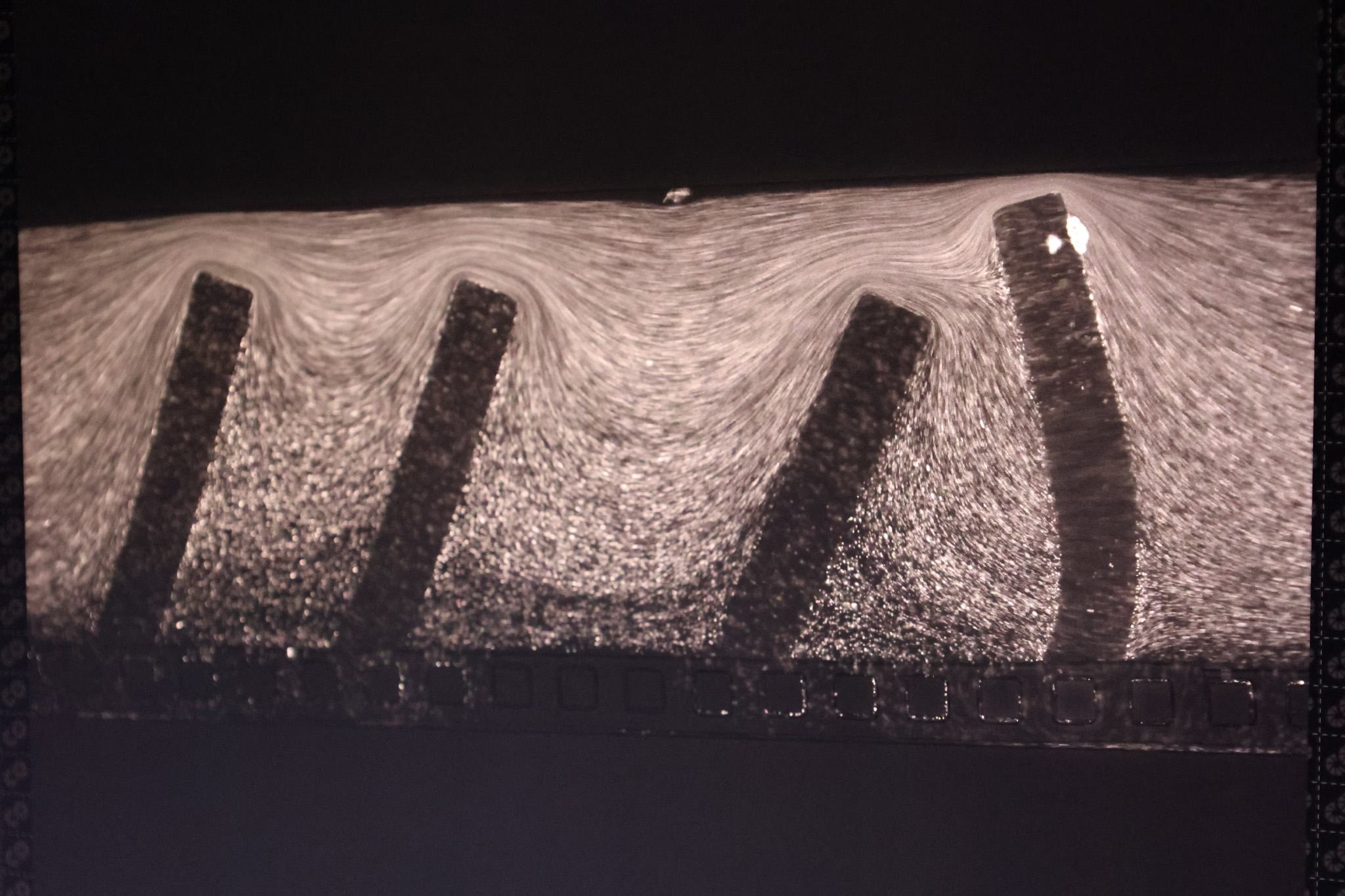
Hysterons provide a minimal description of memory in driven matter: bistable elements with distinct switching thresholds whose collective dynamics generate hysteresis, avalanches, and history-dependent switching. Experimental realizations have so far been dominated by solid-state mechanical systems, where bistability is usually encoded structurally through buckling, snap-through, or geometric incompatibility. Here we realize hysteron physics through a hydrodynamic route. A single elastic fiber anchored in a microfluidic channel becomes bistable through nonlinear elastohydrodynamic feedback: Viscous loading deforms the fiber, deformation reshapes hydraulic resistance, and flow redistribution modifies the loading. This feedback produces a fluidic hysteron whose onset is organized by a cusp catastrophe in geometric control parameters. A parallel bypass channel acts as a geometric load line that reshapes, and can even eliminate, bistability while simultaneously mediating long-ranged hydraulic interactions between fibers. In arrays, varying a single geometric parameter drives a transition from a noninteracting Preisach regime with return-point memory to an interacting regime with configuration-dependent thresholds, mixed-direction switching paths, and projected trajectories that cross the independent-Preisach envelope. These results establish a passive hydrodynamic route to hysteron networks, in which memory emerges from flow-structure feedback and global hydraulic constraints.