2026-09-28 ジョージア工科大学
<関連情報>
- https://news.research.gatech.edu/2026/09/28/can-machine-or-ai-agent-be-surprised-helping-autonomous-systems-respond-unexpected
- https://pubsonline.informs.org/doi/10.1287/ijds.2026.0182
相互情報サプライズ:自律システムにおける予期せぬ事態の再考 Mutual Information Surprise: Rethinking Unexpectedness in Autonomous Systems
Yinsong Wang, Quan Zeng, Xiao Liu, Yu Ding
INFORMS Journal on Data Science Published:4 Aug 2026
DOI:https://doi.org/10.1287/ijds.2026.0182
Abstract
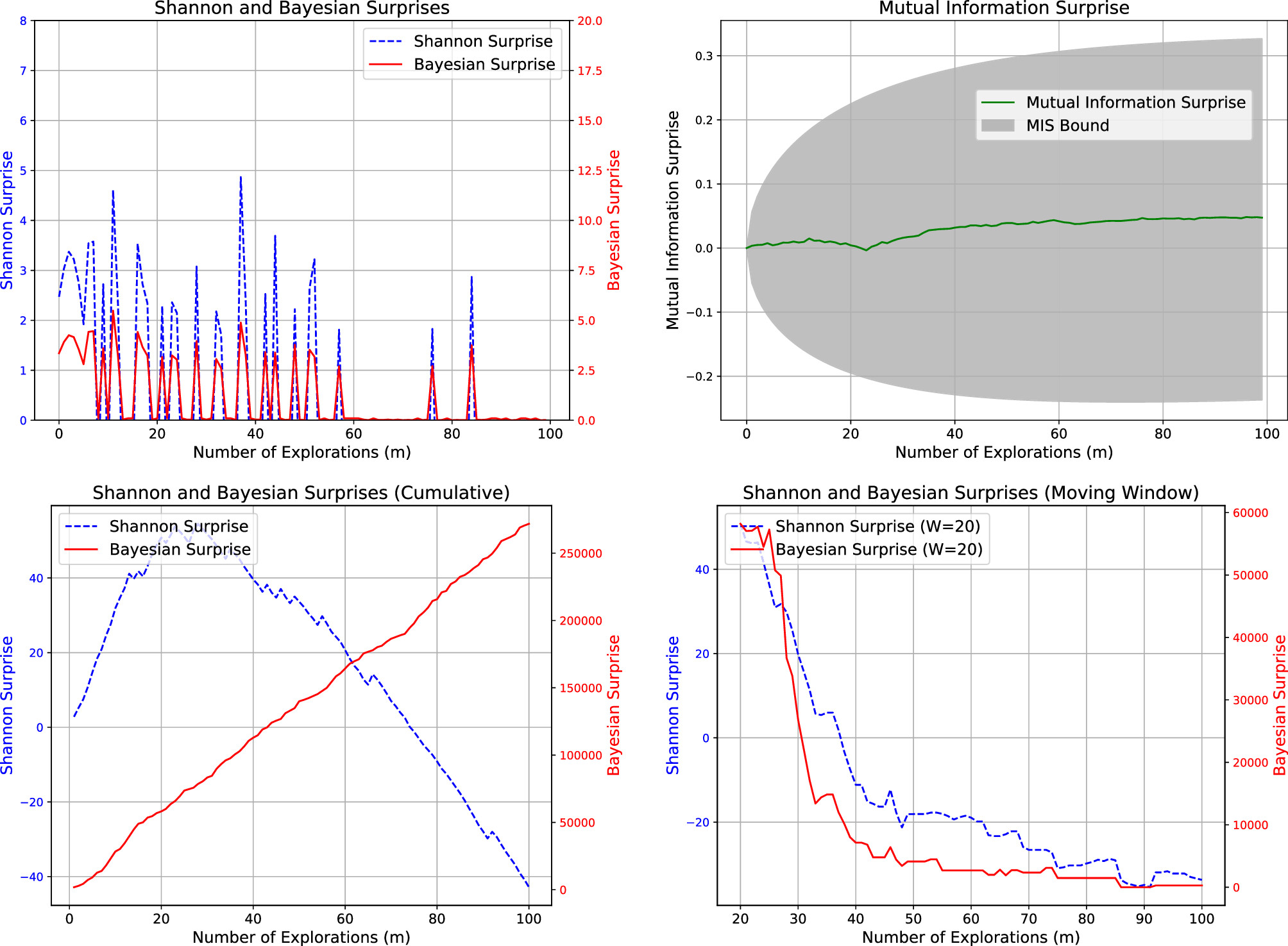
A community of researchers appears to think that a machine can be surprised and have introduced various surprise measures, principally the Shannon surprise and the Bayesian surprise. The questions of what constitutes a surprise and how to react to one still elicit debates. In this work, we introduce mutual information surprise (MIS), a new framework that redefines surprise not as an anomaly measure, but as a signal of epistemic growth. Furthermore, we develop a statistical test sequence that could trigger a surprise reaction and propose a MIS-based reaction policy that dynamically governs system behavior through sampling adjustment and process forking. Empirical evaluations—on both synthetic domains and a dynamic pollution map estimation task—show that a system governed by the MIS-based reaction policy significantly outperforms those under classical surprise-based approaches in stability, responsiveness, and predictive accuracy. The important implication of our new proposal is that MIS quantifies the impact of new observations on mutual information, shifts surprise from reactive to reflective, enables reflection on learning progression, and thus offers a path toward self-aware and adaptive autonomous systems. We expect the new surprise measure to play a critical role in further advancing autonomous systems on their ability to learn and adapt in a complex and dynamic environment.