2026-09-23 シンガポール国立大学(NUS)
<関連情報>
- https://news.nus.edu.sg/worlds-most-accurate-atomic-clock/
- https://www.nature.com/articles/s41586-026-11072-8
Lu +光周波数基準、精度は19桁目で検証済み Lu+ optical frequency references with accuracy verified at the 19th digit
K. J. Arnold, M. D. K. Lee, Qi Zhao, Qichen Qin, Zhao Zhang, N. Jayjong & M. D. Barrett
Nature Published:23 September 2026
DOI:https://doi.org/10.1038/s41586-026-11072-8
Abstract
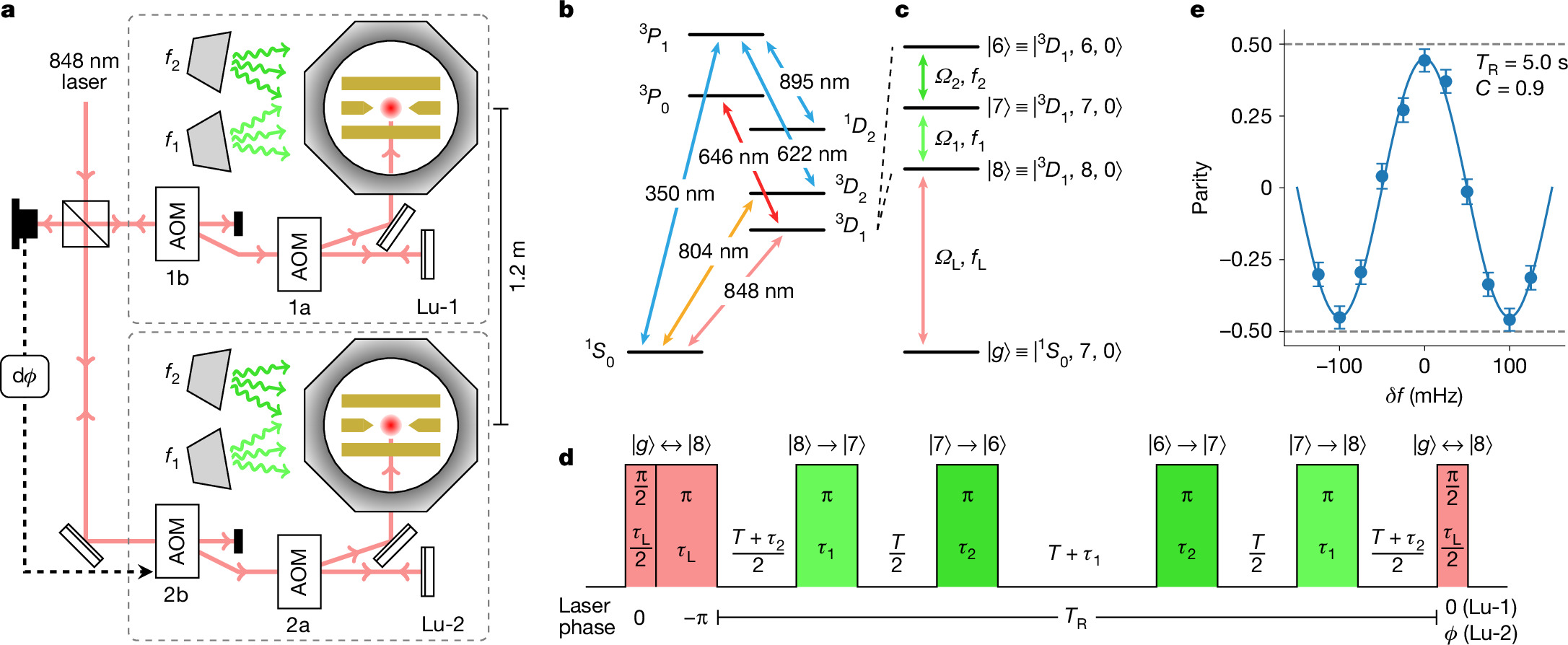
Optical atomic frequency references1 have far surpassed their microwave frequency predecessors, leading to an anticipated redefinition of the SI (International System of Units) second2. However, as the scientific community seeks consensus on a new standard, and several state-of-the-art optical standards now report evaluated fractional uncertainties below 10−18, verification by same-species comparisons to comparable levels remains an outstanding challenge. Here we report two 176Lu+ single-ion optical frequency references, each with evaluated fractional frequency uncertainty near 1 × 10⁻¹⁹, which are directly compared by correlation spectroscopy and demonstrate agreement, with a measured relative frequency difference of [−0.1 ± (5.7)stat ± (1.0)sys] × 10−19, where ‘stat’ and ‘sys’ indicate the statistical and systematic uncertainty, respectively. Our optical references have been comprehensively assessed with evaluated uncertainties below 10−18, supported by a same-species comparison of independent systems to the 5.7 × 10⁻¹⁹ level. This accuracy, achieved in practical room-temperature systems, will contribute to improving international timekeeping and towards chronometric levelling3,4 at the millimetre scale, as well as tests of fundamental physics5 such as Lorentz invariance6, general relativity7, searches for dark matter8,9 and variation of fundamental constants10,11.