2026-09-23 イェール大学
<関連情報>
- https://news.yale.edu/2026/09/23/roaming-black-holes-may-tell-hidden-history-galaxies
- https://iopscience.iop.org/article/10.3847/2041-8213/ae9c38
ブラックホールの占有率:種まき、ダイナミクス、銀河形成の化石記録 The Black Hole Occupation Fraction as a Fossil Record of Seeding, Dynamics, and Galaxy Assembly
Emma Jane Weller, Priyamvada Natarajan, and Colin J. Burke
The Astrophysical Journal Letters Published: 2026 September 7
DOI:10.3847/2041-8213/ae9c38
Abstract
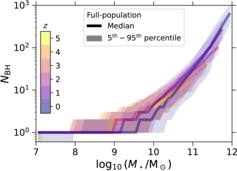
The black hole occupation fraction (BHOF) is a powerful but intrinsically layered diagnostic of massive black hole (BH) seeding and subsequent galaxy assembly. We measure the total, central, and wandering BHOF in the ASTRID cosmological hydrodynamical simulation from z = 5 to z = 0 in galaxies with stellar masses ranging from 107 to 1012 M⊙. For the full population, the total BHOF remains close to unity across most stellar masses and redshifts, reflecting efficient seeding in eligible halos. At low stellar masses, the central BHOF declines toward the present day, while the wandering BHOF rises, indicating that mergers deposit BHs at off-center locations in galaxies. Compared to these full-population BHOFs, the heavy-seed BHOFs are substantially smaller at the low-mass end. The active BHOFs are smaller at all stellar masses, especially at late times, demonstrating that active galactic nuclei (AGN)-selected samples trace duty cycles rather than intrinsic BH occupation. At z = 0, primary (central) galaxies have higher BHOFs than satellites, and star-forming low-mass galaxies preferentially host wandering rather than central BHs. Our results show that the BHOF, when decomposed by BH location, seeding history, accretion state, and larger-scale galactic environment, encodes a rich fossil record of BH origins and dynamics.