
2026-06-08 マサチューセッツ工科大学(MIT)
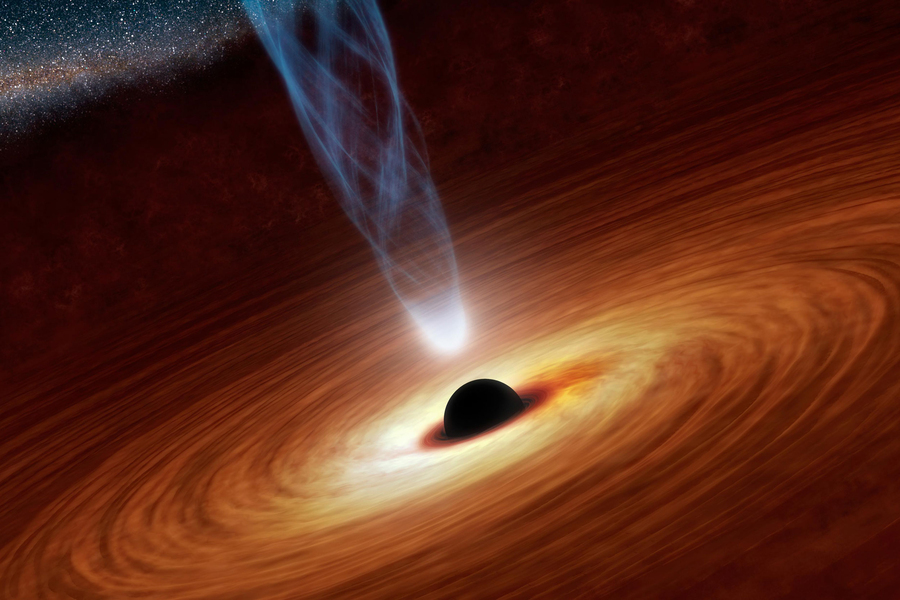
Astronomers at MIT and elsewhere have detected a quasar flickering from the very early universe. This artist’s concept illustrates a quasar accretion disk. Image credit: NASA/JPL-Caltech
<関連情報>
- https://news.mit.edu/2026/mit-astronomers-discover-earliest-known-flickering-quasar-0608
- https://www.nature.com/articles/s41550-026-02897-4
宇宙の黎明期におけるクエーサーの変動性と初期降着円盤の痕跡の発見 Discovery of quasar variability and early accretion disk signatures at cosmic dawn
Gene C. K. Leung,Anna-Christina Eilers,Christos Panagiotou,Julien Wolf,Kishalay De,Luke Weisenbach,Minghao Yue,Xiaohui Fan,Yuzo Ishikawa,Erin Kara,Mirko Krumpe,Andrea Merloni,Robert A. Simcoe,Feige Wang & Jinyi Yang
Nature Astronomy Published:08 June 2026
DOI:https://doi.org/10.1038/s41550-026-02897-4
Abstract
In the nearby universe, quasars are well known to exhibit variability in their brightness over time, offering a powerful tool to probe the physics of accretion onto the supermassive black hole (SMBH) and directly measure the mass of the SMBH. However, detecting variability in early quasars remains challenging. Here we report the detection of multiwavelength infrared and X-ray variability in a quasar observed just 850 million years after the Big Bang. The infrared variability spans five filters, tracing rest-frame ultraviolet and optical emission from the accretion disk, while the X-ray variability probes the corona. The variable spectrum reveals that the accretion disk has a geometrically thin, optically thick structure. This provides observational constraints on the accretion disk structure at early times, when quasars are accreting at high Eddington ratios and reside in extreme environments. Our findings demonstrate the feasibility of characterizing accretion physics using variability in the early universe, laying the groundwork for studies exploiting upcoming facilities such as the Rubin Observatory and Roman Space Telescope. These facilities will discover large samples of variable high-redshift quasars, enabling population-level variability studies of accretion physics and black hole masses, filling key missing ingredients in understanding early SMBH growth.

