

2026-09-17 ローレンス・バークレー国立研究所(LBNL)
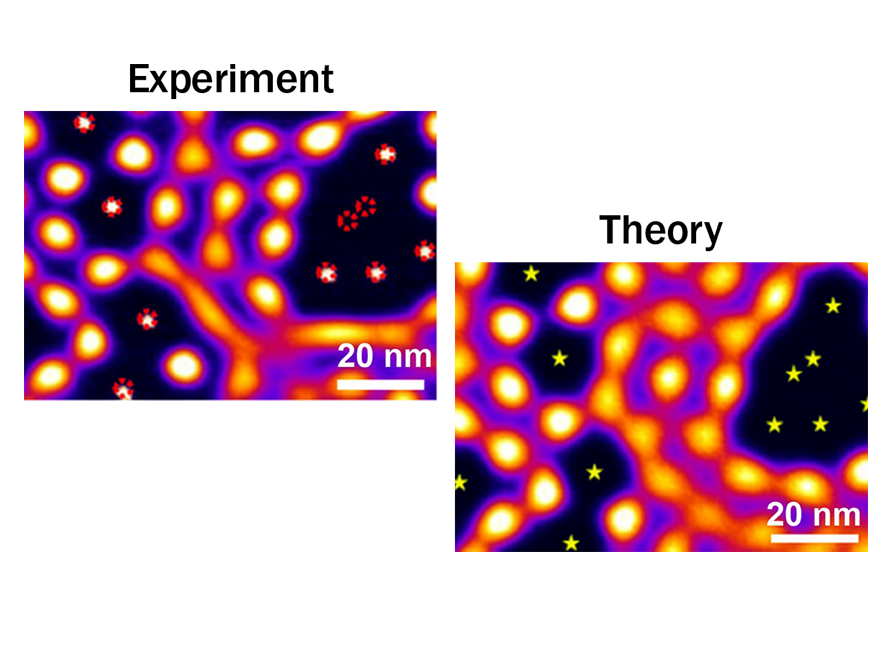
The experimental image on the left is a scanning tunnelling microscope image of the research team’s 2D semiconductor device. (Credit: Berkeley Lab)
<関連情報>
- https://newscenter.lbl.gov/2026/09/17/a-new-close-up-view-of-electrons-inside-semiconductors/
- https://www.nature.com/articles/s41586-026-10654-w
2次元電子ウィグナー固体における急冷された無秩序の影響の可視化 Visualizing the impact of quenched disorder on 2D electron Wigner solids
Zhehao Ge, Conor Smith, Zehao He, Yubo Yang, Qize Li, Ha-Leem Kim, Ziyu Xiang, Jianghan Xiao, Wenjie Zhou, Salman Kahn, Aining Hu, Melike Erdi, Rounak Banerjee, Takashi Taniguchi, Kenji Watanabe, Seth Ariel Tongay, Miguel A. Morales, Shiwei Zhang, Feng Wang & Michael F. Crommie
Nature Published:17 June 2026
DOI:https://doi.org/10.1038/s41586-026-10654-w
Abstract
Electron Wigner solids (WSs)1,2,3,4,5,6,7,8,9,10,11,12 provide an ideal system for understanding the competing effects of electron–electron and electron–disorder interactions, a central unsolved problem in condensed matter physics. Progress in this topic has been limited by a lack of single-defect-resolved experimental measurements as well as accurate theoretical tools to enable realistic experiment/theory comparison. Here we overcome these limitations by combining atomically resolved scanning tunnelling microscopy (STM) with neural-quantum-state quantum Monte Carlo (NQS-QMC) simulation of disordered 2D electron WSs to discover new disorder-induced physical regimes of correlated electron behaviour. STM was used to image the electron density (ne)-dependent evolution of electron WSs in gate-tunable bilayer MoSe2 (BL-MoSe2) devices with varying long-range (nLR) and short-range (nSR) disorder densities. These images were compared with NQS-QMC simulations using realistic disorder maps extracted from experiment, thus allowing the roles of different disorder types to be disentangled. We identify two distinct physical regimes for disordered electron WSs that depend on nSR. For nSR ≲ ne, the WS behaviour is dominated by long-range disorder and features extensive mixed solid–liquid phases, a new type of local re-entrant melting/crystallization and prominent Friedel oscillations. By contrast, when nSR ≫ ne, these features are suppressed and a more robust amorphous WS phase emerges that persists to higher ne, highlighting the importance of short-range disorder in this regime. Our work establishes a powerful framework for studying disordered quantum solids through a combined experimental–theoretical approach.

