2026-08-21 中国科学院(CAS)
<関連情報>
- https://english.cas.cn/newsroom/research-news/202608/t20260813_1187886.shtml
- https://www.nature.com/articles/s44460-026-00127-y
深層学習によって強化された相乗的センシングによる、インテリジェントな認識とナビゲーションを実現するバイモーダルセンサー A bimodal sensor with deep learning-enhanced synergistic sensing for intelligent recognition and navigation
Binzhe Zhao,Danning Gao,Xi Hu,Haoyuan Chen,Zhixun Wang,Lei Wang,Guohua Zhong,Lei Wei,Chunlei Yang & Ming Chen
Nature Sensors Published:20 August 2026
DOI:https://doi.org/10.1038/s44460-026-00127-y
Abstract
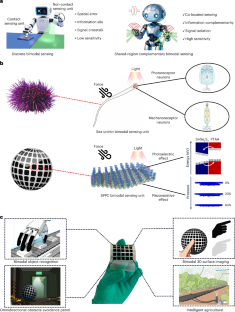
Flexible sensors are widely used in emerging intelligent systems giving the ability to perceive and interact with complex environments through multimodal signals. However, most existing devices rely on spatially separated or independently acquired modalities, limiting synchronous perception, introducing crosstalk and hindering robust data fusion. Here we present a bio-inspired flexible bimodal sensor that integrates co-located photoelectric and pressure sensing within a vertically stacked architecture with intrinsically decoupled outputs. The device combines a SnSexSy/PTAA heterojunction for efficient broadband photodetection with a covalently interlocked polypropylene/functionalized carbon nanotube network for highly linear, sensitive pressure sensing, achieving good responsivity, low detection limits and minimal (<1%) cross-channel interference. By fusing multimodal signals, the sensor enables accurate object recognition, mapless robotic navigation in simulated fire and tracking soil moisture and light intensity for environmental monitoring. These results establish a material and architectural paradigm for synergistic bimodal sensing, with broad implications for embodied intelligence, human–machine interfaces and precision agriculture.