2026-09-15 合肥物質科学研究院(HFIPS)
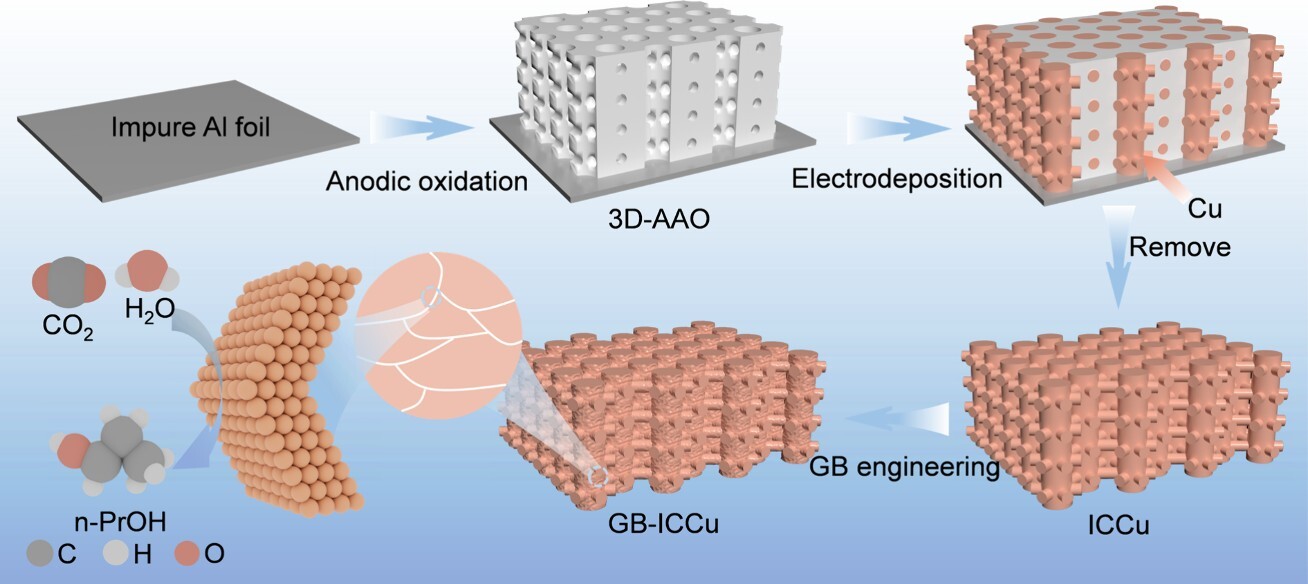
Schematic illustration of the synthesis process of the GB-ICCu electrode (Image by TANG Haibin)
<関連情報>
- https://english.hf.cas.cn/nr/rn/202609/t20260915_1200488.html
- https://onlinelibrary.wiley.com/doi/10.1002/eem2.70498
- https://pubs.acs.org/ancac3/article-abstract/20/21/15502/5108788/Synergistic-Coupling-between-Nanoconfinement-and
二酸化炭素を一酸化炭素に効率的かつ選択的に電気還元するための三次元相互接続銀ナノワイヤ膜 Three-Dimensionally Interconnected Silver Nanowire Membrane for Efficient and Selective Electroreduction of Carbon Dioxide to Carbon Monoxide
Pengxiang Wang, Lei Wang, Haibin Tang, Ao Wang, Dongran Wang, He Liu, Chenyu Cai, Fangming Han, Guowen Meng
ENERGY & ENVIRONMENTAL MATERIALS Published: 10 August 2026
DOI:https://doi.org/10.1002/eem2.70498
Abstract
Silver-based nanostructures are widely believed as the promising catalysts for electrocatalytic reduction of carbon dioxide toward carbon monoxide. However, most reported Silver-based catalysts are typically synthesized in powder form and require polymeric binders for electrode fabrication, resulting in several interrelated issues including blocked active sites, poor electrical conductivity, limited mass transport, and weak adhesion between the catalyst layer and the substrate. Herein, utilizing a three-dimensionally porous anodic aluminum oxide template, a self-supported 3D interconnected Ag nanowire membrane is fabricated as a electrocatalytic reduction of carbon dioxide electrode. This unique architecture offers a large electrochemical active surface area and abundant active sites, enabling the efficient and highly selective conversion of carbondioxide to carbon monoxide over a wide potential window, with a maximum Faradaic efficiency for carbon monoxide of 97.28% and high current density of 59.06 mA cm−2 in the typical H-type cell. Furthermore, the scaffold-like 3D interconnected structure ensures excellent structural stability, guaranteeing long-term operational durability. This work provides a novel catalyst design strategy for highly selective electrocatalytic reduction of carbon dioxide to carbon monoxide and a feasible solution for durable self-supporting electrodes.