2026-09-09 東北大学
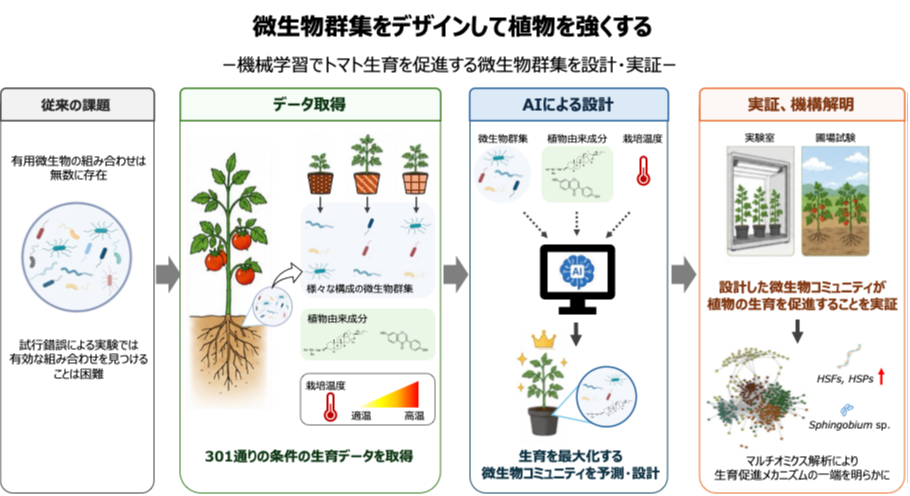
図1. 本研究の概要。
<関連情報>
- https://www.tohoku.ac.jp/japanese/2026/09/press20260909-01-defined.html
- https://academic.oup.com/ismej/advance-article/doi/10.1093/ismejo/wrag219/8770986
モデルに基づいた微生物群集の設計により、植物の成長とストレス耐性を支える相互作用が明らかになる Model-guided design of defined microbial community reveals interactions underpinning plant growth and stress tolerance
Shinichi Yamazaki,Masaru Nakayasu,Keiko Kanai,Rie Mizuno,Rumi Kaida,Sachiko Masuda,Arisa Shibata,Ken Shirasu,Atsushi J Nagano,Yoshiharu Fujii,…
The ISME Journal Published:26 August 2026
DOI:https://doi.org/10.1093/ismejo/wrag219
Abstract
Defined microbial communities (DMCs; also known as SynComs) offer a promising strategy to enhance plant growth and stress tolerance by harnessing beneficial plant-associated microbes. However, the rational design and efficient exploration of complex DMC configurations remain challenging. Here, we present an interpretable model-guided framework that integrates plant phenotyping, microbial genomics, and machine learning to optimize DMC outcomes and identify microbial interactions relevant to plant performance. Using tomato as a model, we evaluated diverse DMC, temperature, and metabolite combinations in growth experiment and used a quality-controlled dataset comprising 301 plants representing 102 DMC compositions for predictive modeling. An Elastic Net regression model trained on plant biomass data and DMC composition features enabled prediction of unseen DMC outcomes, and incorporating genomic features substantially improved predictive performance, supporting the importance of functional potential in modeling community effects. We applied the model to prioritize and design improved DMCs, which were validated in laboratory assays and field trials. One model-guided DMC significantly enhanced plant growth in the field and improved heat stress tolerance under controlled conditions. Model interpretation and multi-omics analyses highlighted specific microbial interactions, including metabolite-associated relationships involving Sphingobium sp. and tomatine, that were linked to host stress-responsive gene expression. Together, our results demonstrate a scalable framework for predicting and prioritizing DMCs and identify candidate metabolite-associated microbial interactions that may contribute to plant growth promotion and abiotic stress tolerance.