2026-09-08 中国科学院(CAS)
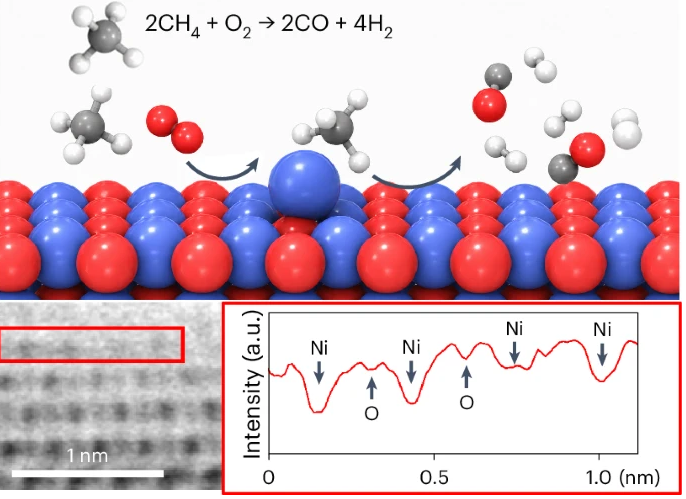
The model and image of the in situ formed [Ni1O4Ni4] active structure. (Image by TAN Yuanlong and LIU Xiaoyan)
<関連情報>
- https://english.cas.cn/newsroom/research-news/202609/t20260908_1192773.shtml
- https://www.nature.com/articles/s41929-026-01580-1
メタンの部分酸化による合成ガス生成過程におけるNi / Al₂O₃上での活性モチーフのその場生成 In situ generation of active motifs on Ni/Al2O3 during partial oxidation of methane to syngas
Yuanlong Tan,Qiao Zhao,Chen Liang,Chaobin Zeng,Hongwen Guo,Fengyuan Liu,Guang Xian Pei,James Hayward,Jingyuan Ma,Han Zhao,Xiao Yan Liu,Wei Liu,Tao Yang,Aiqin Wang,Graham J. Hutchings & Tao Zhang
Nature Catalysis Published:14 August 2026
DOI:https://doi.org/10.1038/s41929-026-01580-1
Abstract
The active phase for the partial oxidation of methane (POM) to syngas on Ni catalysts has been attributed to metallic nanoparticles, with high Ni loadings (~10 wt%) considered essential. Here we show, on NiO surfaces, that in situ-generated [Ni1O1Ni4] motifs, where one Ni atom sits on an oxygen atom that bridges four surrounding Ni atoms, drive POM with promising efficiency. A Ni/Al2O3-ME catalyst with Ni loading of 0.8 wt% fabricated via deposition of preformed Ni nanoparticles onto Al2O3 achieves 92.0% CH4 conversion and 87.0% CO/H2 selectivity at 650 °C for POM, maintaining a stable H2/CO ratio of 2.0. Operando spectroscopy and environmental microscopy confirm the oxidation of metallic Ni to NiO during POM. The results of operando high-resolution annular bright-field imaging, combined with density functional theory calculations, suggest that the [Ni1O1Ni4] structure formed on the NiO(100) surface reduces the C–H activation barrier to 12.5 kcal mol−1. Thus, metallic Ni nanoparticles with high metal loadings may not be strictly required for efficient POM.