2026-08-26 合肥物質科学研究院(HFIPS)
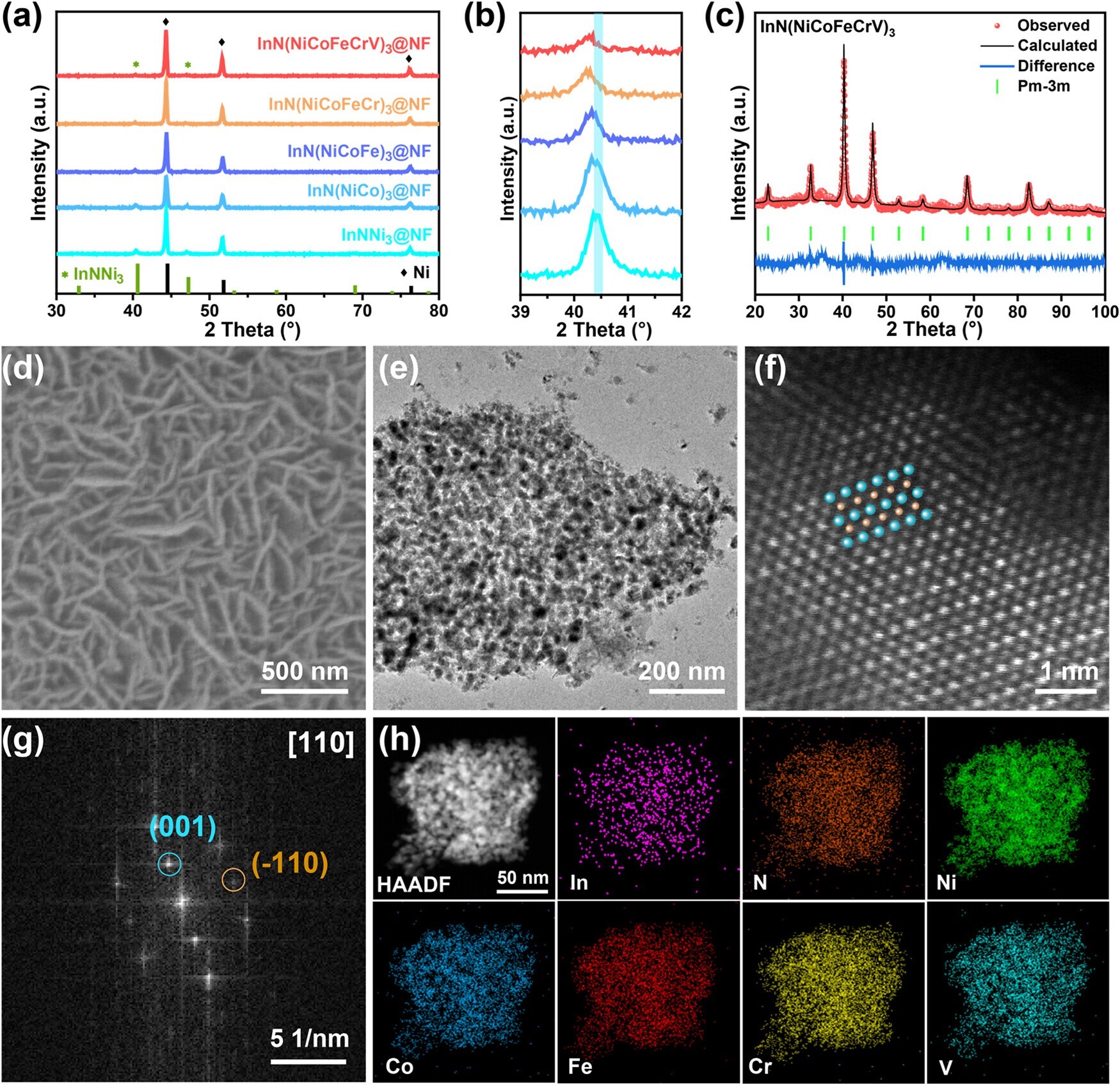
Structural and morphological characterization of the InN(NiCoFeCrV)₃@NF integrated electrode (Image by Chenbin)
<関連情報>
- https://english.hf.cas.cn/nr/bth/202608/t20260826_1188940.html
- https://pubs.acs.org/ancac3/article-abstract/20/27/19287/5169986/Defect-Driven-Surface-Reconstruction-in-High
高エントロピー反ペロブスカイトにおける欠陥駆動型表面再構成によるモット・ショットキー界面の生成と酸素発生の促進 Defect-Driven Surface Reconstruction in High-Entropy Antiperovskite to Generate Mott–Schottky Interface for Boosting Oxygen Evolution
Jing Zhang;Rui Wan;Yuguang Wang;Xiaoxiao Wu;He Liu;Bin Chen ;Guowen Meng
ACS Nano Published:June 29, 2026
DOI:https://doi.org/10.1021/acsnano.6c02462
Abstract
Anion exchange membrane (AEM) water electrolysis is a promising strategy for green hydrogen production, which enables the use of non-precious-metal catalysts. However, the activity and stability of oxygen evolution reaction (OER) catalysts are far from meeting the requirements of AEM water electrolysis at high current density. Herein, we report a high-entropy antiperovskite InN(NiCoFeCrV)3 on nickel foam (denoted as InN(NiCoFeCrV)3@NF) as a structurally integrated electrode for boosting the OER process. The high-entropy-driven elemental synergy effectively promotes the reconstruction dynamics and creates more active sites. The leaching of Cr/V triggers surface reconstruction to generate oxyhydroxides as the real active phases. Subsequently, the Mott–Schottky heterojunctions are established at the interface of oxyhydroxides and InN(NiCoFeCrV)3, which creates a built-in electric field and offers a fast charge transfer path. Moreover, the high-entropy effect modulates the electronic structure and optimizes the OER process. The combined high conductivity and structural stability of InN(NiCoFeCrV)3 enable efficient and durable water oxidation at high current densities. The InN(NiCoFeCrV)3@NF electrode exhibits an ultralow overpotential of 279 mV at 100 mA cm–2. The integrated AEM electrolyzer with InN(NiCoFeCrV)3@NF shows an ultralow cell voltage of 1.70 V to achieve a high current density of 500 mA cm–2 with outstanding stability for over 400 h. This work not only reports a strategy to design highly active and stable OER electrocatalysts for AEM electrolyzers but also provides insights into the charge transfer mechanism of antiperovskites.