2026-08-20 京都大学
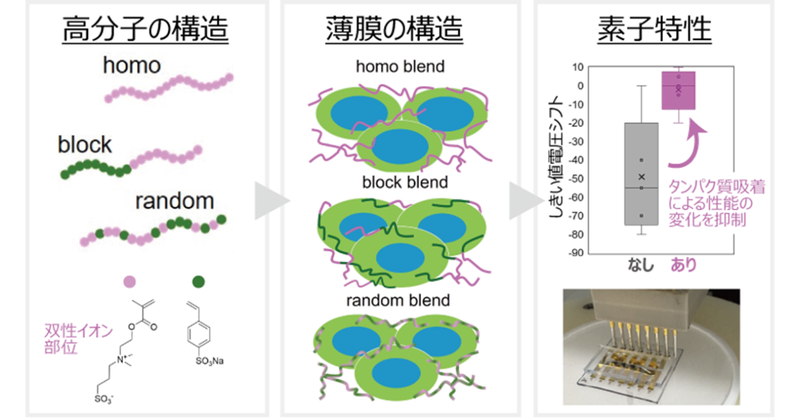
図1 高分子の配列設計が薄膜の構造と素子特性の動作安定性に与える影響
<関連情報>
- https://www.t.kyoto-u.ac.jp/ja/research/topics/20260820-1
- https://advanced.onlinelibrary.wiley.com/doi/10.1002/aelm.70502
有機電気化学トランジスタの電荷輸送と安定性を向上させる双性イオン高分子/PEDOT:PSSブレンド膜の高分子配列設計 Polymer Sequence Design of Zwitterionic Polymer/PEDOT:PSS Blend Films for Improved Charge Transport and Stability in Organic Electrochemical Transistors
Wakana Takahashi, Aki Kashiwazaki, Masaya Mitsuishi, Shunsuke Yamamoto
Advanced Electronic Materials Published: 13 August 2026
DOI:https://doi.org/10.1002/aelm.70502
ABSTRACT
Organic electrochemical transistors (OECTs) require antifouling channel materials to operate stably in biological environments. Here, we demonstrate a simple strategy to introduce antifouling functionality into PEDOT:PSS-based OECTs using zwitterionic polymers. Homo-, random-, and block-type zwitterionic polymers are synthesized and mixed with PEDOT:PSS via solution processing, enabling the fabrication of blend films without additional steps. Structural and spectroscopic analyses show that the zwitterionic polymers are retained within the films, maintaining the doping state and crystalline structure of PEDOT:PSS. Instead, differences in polymer architecture produce distinct structural features within the preserved core–shell PEDOT:PSS framework, including variations in the apparent shell thickness and, for zwitterionic (co)monomer components, the formation of an outer polymer-rich region. These structural differences directly influence charge transport. Electrochemical and OECT measurements reveal reductions in volumetric capacitance and transconductance, mainly due to decreased apparent mobility. Protein adsorption studies further show reduced device degradation upon exposure to two proteins: bovine serum albumin and fibronectin. This blending strategy provides a practical route to antifouling, solution-processable OECT materials for bioelectronic interfaces.