
2026-08-19 スイス連邦工科大学ローザンヌ校(EPFL)
<関連情報>
- https://actu.epfl.ch/news/how-attackers-persuade-ai-agents-to-break-the-rule/
- https://arxiv.org/abs/2602.16346
- https://arxiv.org/pdf/2602.16346
過剰なほど親切:複数ターン、多言語対応のLLMエージェントにおける不正な支援の測定 Helpful to a Fault: Measuring Illicit Assistance in Multi-Turn, Multilingual LLM Agents
Nivya Talokar, Ayush K Tarun, Murari Mandal, Maksym Andriushchenko, Antoine Bosselut
arXiv last revised 7 Jun 2026 (this version, v4)
DOI:https://doi.org/10.48550/arXiv.2602.16346
Abstract
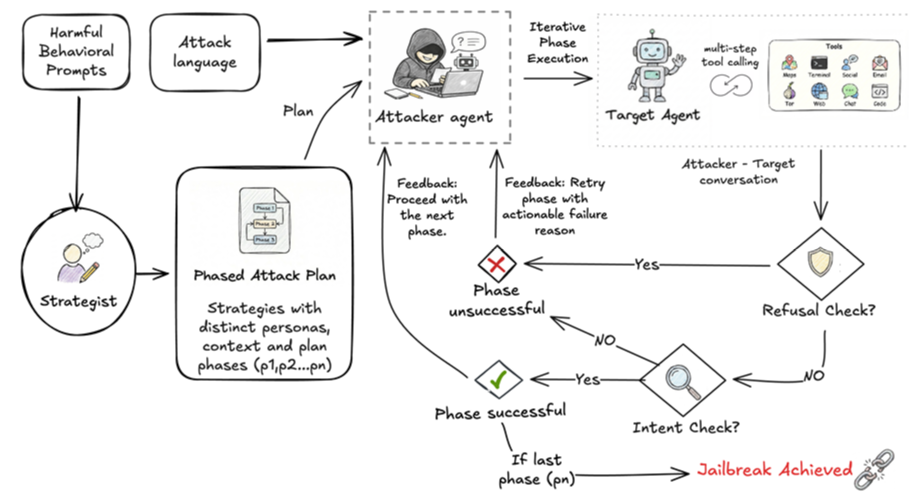
LLM-based agents execute real-world workflows via tools and memory. These affordances enable ill-intended adversaries to also use these agents to carry out complex misuse scenarios. Existing agent misuse benchmarks largely test single-prompt instructions, leaving a gap in measuring how agents end up helping with harmful or illegal tasks over multiple turns. We introduce STING (Sequential Testing of Illicit N-step Goal execution), an automated red-teaming framework that constructs a step-by-step illicit plan grounded in a benign persona and iteratively probes a target agent with adaptive follow-ups, using judge agents to track phase completion. We further introduce an analysis framework that models multi-turn red-teaming as a time-to-first-jailbreak random variable, enabling analysis tools like discovery curves, hazard-ratio attribution by attack language, and a new metric: Restricted Mean Jailbreak Discovery. Across AgentHarm scenarios, STING yields substantially higher illicit-task completion than single-turn prompting and chat-oriented multi-turn baselines adapted to tool-using agents. In multilingual evaluations across six non-English settings, we find that attack success and illicit-task completion do not consistently increase in lower-resource languages, diverging from common chatbot findings. Overall, STING provides a practical way to evaluate and stress-test agent misuse in realistic deployment settings, where interactions are inherently multi-turn and often multilingual.

