2026-08-18 サンディア国立研究所(SNL)
<関連情報>
- https://newsreleases.sandia.gov/teaching-drones-to-play-tag/
- https://coogan.ece.gatech.edu/papers/pdf/llanes2026marl.pdf
マルチエージェント強化学習を用いたドローンスウォームの協調戦略の学習 Learning Cooperative Strategies for Drone Swarms using Multi-Agent Reinforcement Learning
Christian Llanes, Kyle A. Williams, Spencer W. Jensen, and Samuel Coogan
Abstract
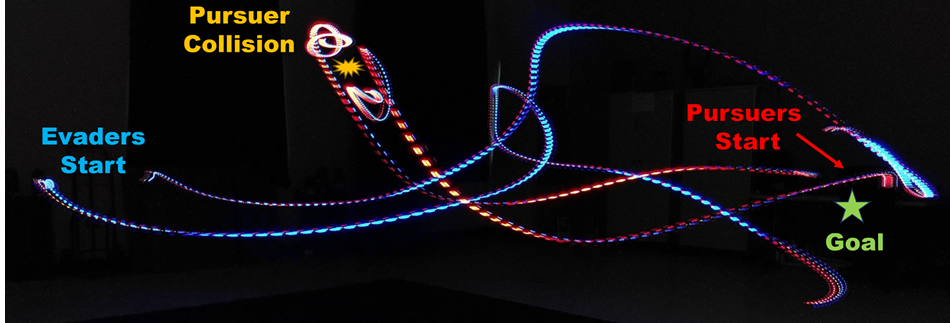
In this work, we investigate cooperative strategies for an evader drone team of various sizes using multi-agent reinforcement learning in a multi-agent pursuit-evasion scenario. The objective of the evader team is to reach a goal with minimal velocity while not colliding with the pursuer team. The objective of the pursuer team is to defend the goal by catching evaders before they reach it. In this environment, we allow the pursuer to have superior control authority compared to the evader such that reaching the goal is challenging for the evader in a one-on-one scenario. The proposed strategy for an evader is to team up with an ally to lead pursuers into a collision with each other instead of intercepting the evader. We design policies using multi-agent proximal policy optimization, an actor-critic reinforcement learning method, and investigate how the learned strategy changes when we vary the size of the pursuer and evader teams. Finally, we demonstrate the learned policy’s sim-to-real capabilities through a hardware demonstration.