2026-07-24 中国科学院(CAS)
<関連情報>
- https://english.cas.cn/newsroom/research-news/202607/t20260727_1179175.shtml
- https://www.sciencedirect.com/science/article/abs/pii/S0304389426019722?via%3Dihub
成層圏大気中のベリリウム同位体シグネチャーの証拠は、チベット高原南部におけるマイクロ/ナノプラスチックの長距離輸送を示している Evidence of beryllium isotope signatures in stratospheric air reveals long distance transport of micro/nano-plastics in the Southern Tibetan Plateau
Xuke Liu, Haogen Li, Yunchong Fu, Guohui Li, Peng Cheng, Guocheng Dong, Wen Liu
Journal of Hazardous Materials Available online: 15 July 2026
DOI:https://doi.org/10.1016/j.jhazmat.2026.142992

Highlights
- The MNPs is 0.0059–0.11 μg/m³ , and the cosmogenic 10Be/7Be is 0.63–1.08 in the southern TP.
- These periods of high MNP concentration are accompanied by strong stratospheric 7Be and 10Be fingerprint signals.
- The unique terrain and vertical circulation over the southern Tibetan Plateau can promote the accumulation of MNPs.
- The magnitude, retention period, and flux of MNP driven by vertical circulation in the upper atmosphere were evaluated.
Abstract
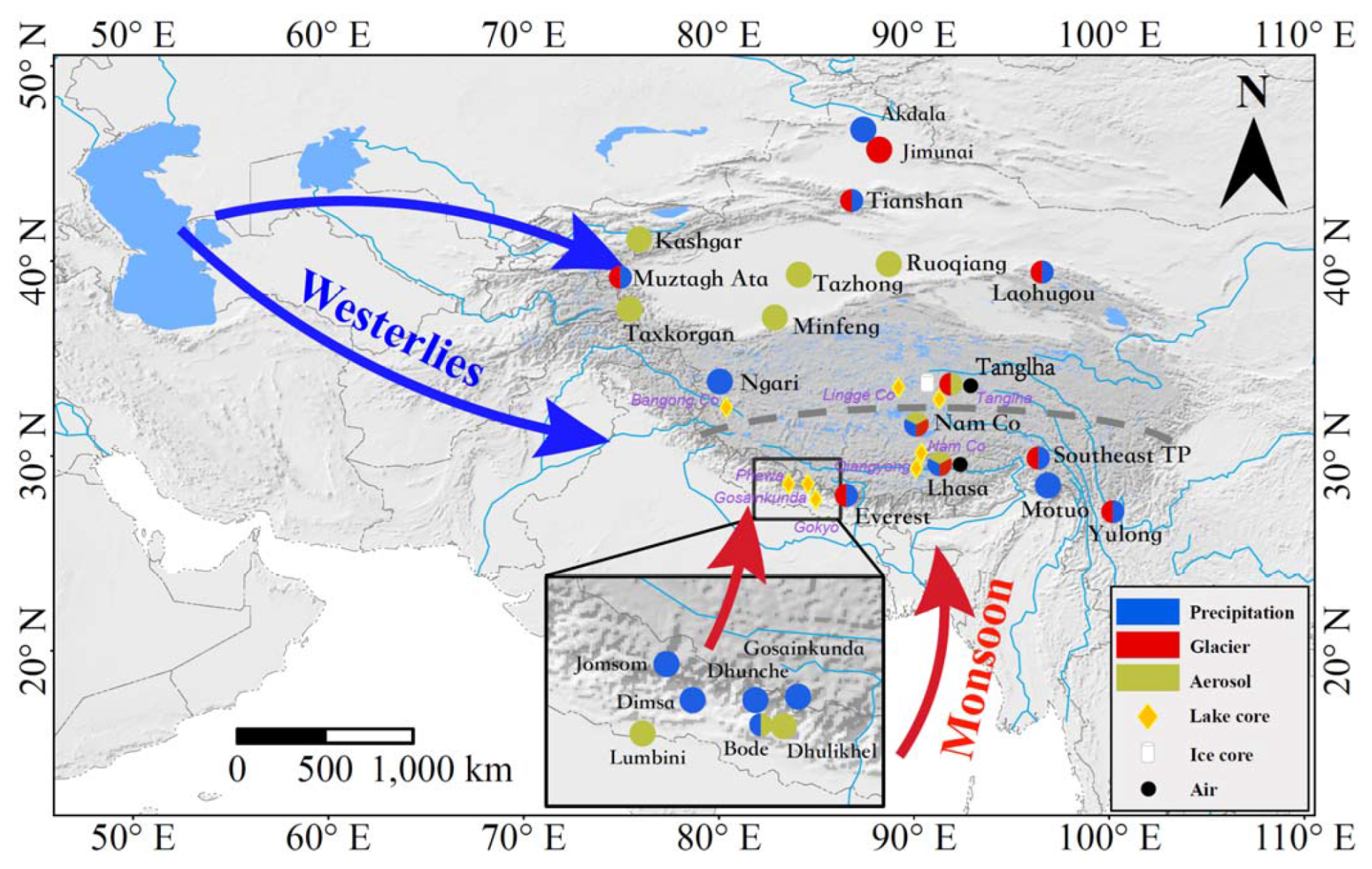
The new threat from atmospheric Micro/nano-plastics (MNPs) emissions now reaches far beyond the conventional scope of plastic-related issues. While MNP horizontal transport within the planetary boundary layer is well understood, limited knowledge of their vertical transport in the free troposphere and stratosphere hinder comprehensive modeling of their global atmospheric circulation. Considering that the production rates of radioactive beryllium isotopes (7Be and 10Be) above the tropopause is over 100 times higher than that in the near surface atmosphere, if relatively high concentrations and ratios of 10Be and 7Be can be observed near the surface, this phenomenon can serve as a unique isotope “fingerprint” for the invasion of deep stratospheric air invasion. Here, we present evidence of MNPs at mass concentrations of 0.0059–0.11 μg/m³ detected in Lhasa, southern Tibetan Plateau. And through synchronous high-precision observations of 7Be and 10Be, we have discovered strong stratospheric air signals during periods of high MNP concentration. Through the atmospheric transport models to delineate the occurrence, magnitude, retention period, flux, and characteristics of MNP pollution driven by upper-atmospheric vertical circulation in this high-elevation region. We found that under special topographic and aerodynamic conditions, atmospheric vertical circulation will promote the accumulation of MNPs for the enrichment and redistribution of MNPs. This work reveals the importance of vertical circulation in the upper atmosphere in the dynamics of MNP circulation based on evidence from beryllium isotopes.