2026-07-24 カリフォルニア大学リバーサイド校(UCR)
<関連情報>
- https://news.ucr.edu/articles/2026/07/24/new-tool-identifies-sources-fake-videos
- https://arxiv.org/abs/2511.12834
- https://arxiv.org/pdf/2511.12834
SAGA:生成AI動画のソース帰属 SAGA: Source Attribution of Generative AI Videos
Rohit Kundu, Vishal Mohanty, Hao Xiong, Shan Jia, Athula Balachandran, Amit K. Roy-Chowdhury
arxiv last revised 2 Apr 2026 (this version, v2)
DOI:https://doi.org/10.48550/arXiv.2511.12834
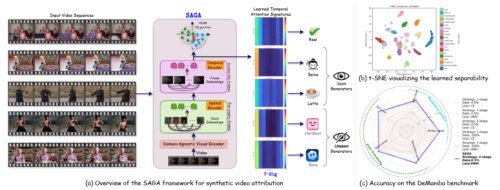
Abstract
The proliferation of generative AI has led to hyper-realistic synthetic videos, escalating misuse risks and outstripping binary real/fake detectors. We introduce SAGA (Source Attribution of Generative AI videos), the first comprehensive framework to address the urgent need for AI-generated video source attribution at a large scale. Unlike traditional detection, SAGA identifies the specific generative model used. It uniquely provides multi-granular attribution across five levels: authenticity, generation task (e.g., T2V/I2V), model version, development team, and the precise generator, offering far richer forensic insights. Our novel video transformer architecture, leveraging features from a robust vision foundation model, effectively captures spatio-temporal artifacts. Critically, we introduce a data-efficient pretrain-and-attribute strategy, enabling SAGA to achieve state-of-the-art attribution using only 0.5\% of source-labeled data per class, matching fully supervised performance. Furthermore, we propose Temporal Attention Signatures (T-Sigs), a novel interpretability method that visualizes learned temporal differences, offering the first explanation for why different video generators are distinguishable. Extensive experiments on public datasets, including cross-domain scenarios, demonstrate that SAGA sets a new benchmark for synthetic video provenance, providing crucial, interpretable insights for forensic and regulatory applications.