2026-07-22 中国科学院(CAS)
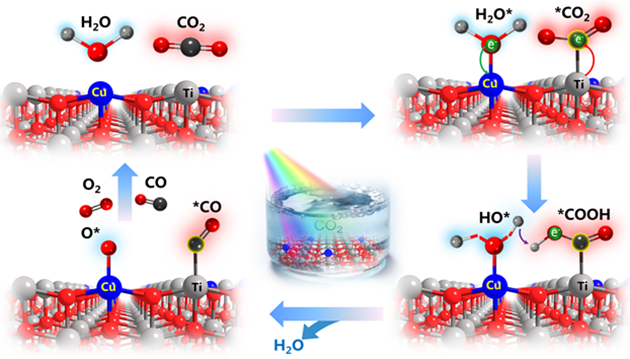
Schematic illustration of the photocatalytic process of CO2 reduction over the Cu-TiO2 catalysts. (Image by LICP)
<関連情報>
- https://english.cas.cn/newsroom/research-news/202607/t20260722_1178928.shtml
- https://www.cell.com/chem-catalysis/abstract/S2667-1093(26)00153-3
CO2光還元用単原子Cu-TiO2触媒における予期せぬ活性部位 Unexpected active sites in single-atom Cu-TiO2 catalysts for CO2 photoreduction
Kangkang Wang ∙ Yajun Zhang ∙ Guojun Dong ∙ Yingpu Bi
Chem Catalysis Published:July 22, 2026
DOI:https://doi.org/10.1016/j.checat.2026.101801
Highlights
- In situ XPS reveals active sites and dynamic catalysis in Cu-TiO2 for CO2 reduction
- H2O adsorption on Cu sites promotes CO2 adsorption/activation on surface Ti sites
- The synergy of Cu and adjacent Ti sites boosts CO2-to-CO conversion efficiency
- This work provides new insights into constructing efficient single-atom catalysts
Summary
Cu single-atom catalysts exhibit great potential for CO2 reduction, but their intrinsic roles under realistic conditions remain debated. Herein, we present compelling evidence elucidating the active sites of Cu-TiO2 single-atom catalysts for CO2 photoreduction with H2O. In situ X-ray photoelectron and infrared spectroscopy reveal that H2O molecules adsorbed at Cu sites inject electrons to induce low valence states, thereby promoting CO2 adsorption on adjacent Ti sites and driving them toward high oxidation states. Under illumination, the CO2 molecules on Ti sites transformed into ∗COOH and CO∗ intermediates, while the H2O molecules dissociated into the OH group on Cu sites to produce protons and electrons. Accordingly, their cooperative catalysis remarkably enhances CO2-to-CO conversion activity (161.1 μmol g−1 h−1), far exceeding that of pristine TiO2 (31.8 μmol g−1 h−1). These findings challenge the conventional speculations on single-atom Cu catalysts and provide new insights for the re-evaluation of static structure-activity models.