2026-07-21 産業技術総合研究所
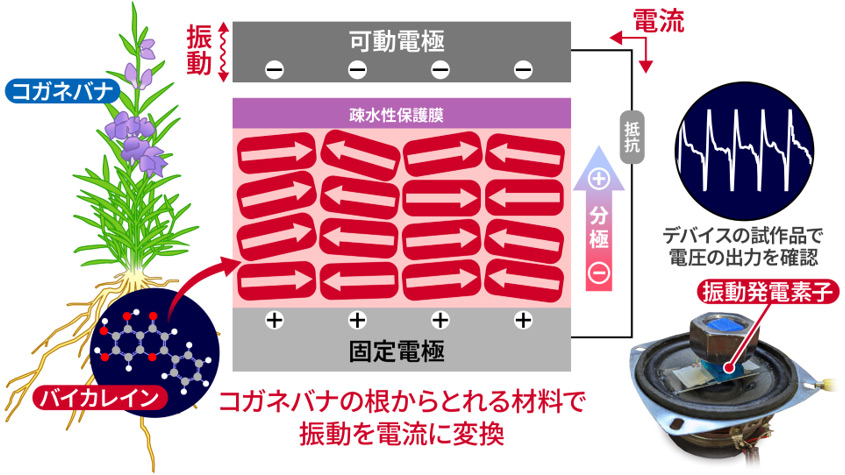
概要図
※原論文の図を引用・改変したものを一部に使用しています。(CC BY-NC)
<関連情報>
- https://www.aist.go.jp/aist_j/press_release/pr2026/pr20260721/pr20260721.html
- https://advanced.onlinelibrary.wiley.com/doi/10.1002/adfm.76653
自己組織化バイオエレクトレットを用いた振動電流発生の実証 Demonstrating Vibrational Current Generation With a Self-Assembled Bioelectret
Kouki Akaike, Yukihiro Shimoi, Qingshuo Wei, Yutaro Ono, Satomi Hosono, Yoichi Yamada, Haruhisa Akiyama, Shunsuke Tanaka
Advanced Functional Materials Published: 20 July 2026
DOI:https://doi.org/10.1002/adfm.76653
ABSTRACT
The widespread adoption of IoT devices has created a strong demand for replacement-free power sources for environmental, physiological, and infrastructure monitoring. Vibrational energy harvesters (VEHs), which convert ambient mechanical vibrations into electricity, offer a promising off‑grid solution. However, their large-scale deployment raises concerns regarding long‑term material supply and end‑of‑life disposal. To address these issues, exploring naturally occurring materials suitable for VEH components is essential. This study demonstrates that baicalein (Bai), a plant‑derived molecule, functions as an electret molecule. Vacuum‑deposited Bai films exhibit spontaneous orientation polarization (SOP), where molecular dipoles partially align along the surface normal, generating a giant surface potential (GSP). Sum‑frequency generation spectroscopy reveals anisotropic molecular layering and strong built-in electric fields. Increasing the evaporation rate boosts the surface polarization-charge density to over 2 mC m−2, comparable to that of commercially available electrets. Although moisture induces rapid depolarization, hydrocarbon‑based surface protection significantly improves air-stability of the electret without immediate GSP loss. Moreover, a sandwich-type device comprising a Bai film generates alternating voltage under mechanical vibrations, confirming its electret functionality without charging treatments. These results establish Bai as the first self‑assembled bioelectret and a sustainable alternative to conventional polymer electrets for VEHs.