2026-07-15 NASA
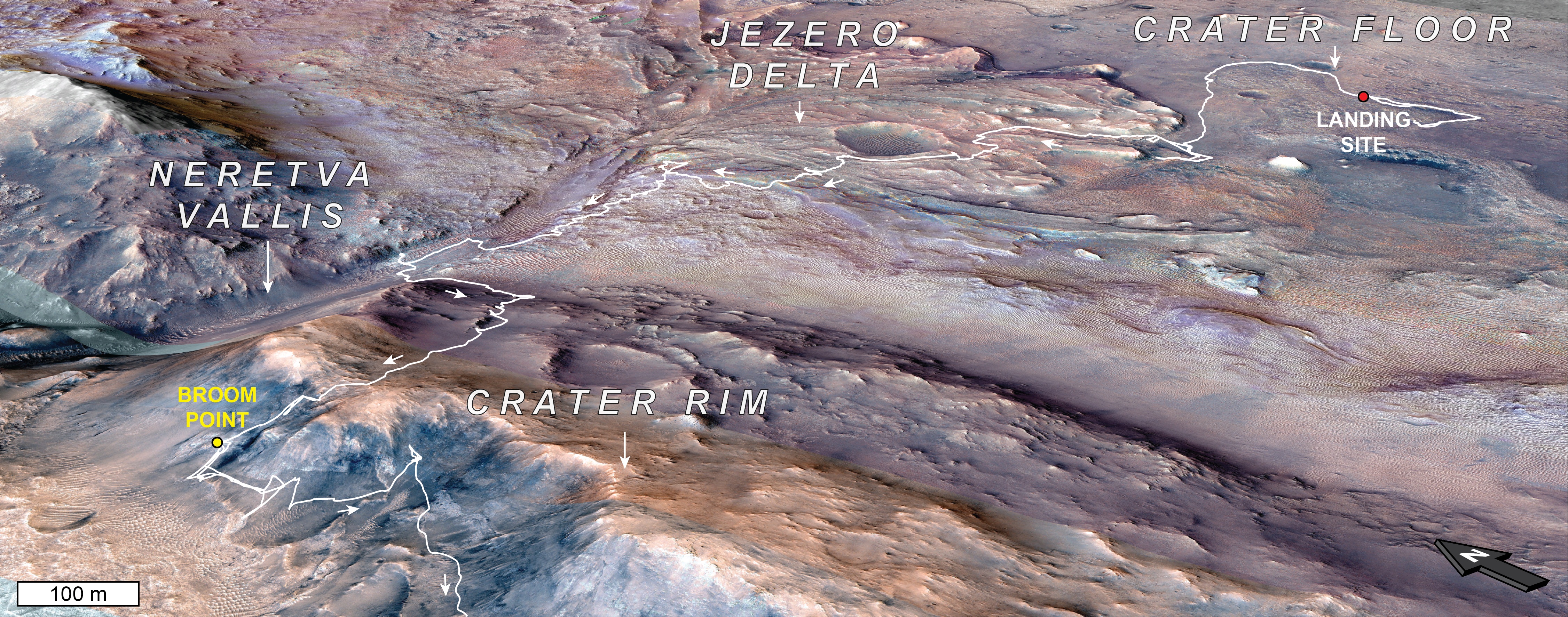
This orbital map shows the path NASA’s Perseverance Mars rover took from its 2021 landing site in Jezero Crater to the “Broom Point” location in mid-2025. NASA/JPL-Caltech/MRO/HIRISE/UA/ICL
<関連情報>
- https://www.nasa.gov/solar-system/planets/mars/nasas-perseverance-rover-reads-record-of-ancient-mars-impacts/
- https://agupubs.onlinelibrary.wiley.com/doi/10.1029/2026JE009779
ジェゼロ・クレーターの縁に保存された地層から、初期火星における度重なる衝突の痕跡が明らかになった Stratigraphy Preserved on the Jezero Crater Rim Reveals Repeated Impacts on Early Mars
Alexander J. Jones, Sanjeev Gupta, Robert Barnes, Samantha Gwizd, Kathryn M. Stack, Briony Horgan, Sanna Alwmark, Athanasios Klidaras, Eleni Ravanis, Sarah Fagents, Gerhard Paar, …
Journal of Geophysical Research: Planets Published: 15 July 2026
DOI:https://doi.org/10.1029/2026JE009779
Abstract
The outer slopes of the western Jezero crater rim are hypothesized to expose sections of Early- to Pre-Noachian crust uplifted by the Jezero impact, providing an excellent opportunity to investigate the earliest geologic processes active on terrestrial planets. Here, we analyze a ∼75-m-thick layered bedrock succession explored by the Perseverance rover on the outer Jezero crater rim, informally named the Broom Point member of the Witch Hazel Hill formation, to reconstruct its emplacement processes. Layering is steeply inclined and offset by rim-transverse faults, consistent with uplifted pre-impact target rock of Noachian age. Lithofacies include clast- and matrix-supported melt-bearing breccias, a planar-laminated to potentially cross-stratified facies containing candidate accretionary lapilli, and an unstratified to weakly laminated facies, with angular silt-sized grains. These lithofacies are interpreted as the products of concentrated, ground-hugging density flows, dilute surges and fall produced by explosive volcanism or impacts. However, millimeter- to sub-millimeter-diameter glassy spherules with vesicular, fluidal and agglutinated morphologies are also present throughout the section, including as a ∼20-cm-thick framework-supported layer. Their morphologies, compositions and distributions appear inconsistent with diagenetic or volcanic spherules, and instead resemble spherules produced by impacts, suggesting that the lithofacies of the Broom Point member were predominantly emplaced as impactites. Geological cross sections and stratigraphic columns were constructed through the unit, and allowed us to reconstruct the depositional evolution of these deposits. The section preserves repeated phases of flow and fall, and intercalated proximal and distal ejecta, suggesting that Mars’ ancient stratified crust preserves evidence for repeated impacts early in its history.