2026-06-12 中国科学院(CAS)
<関連情報>
- https://english.cas.cn/newsroom/research-news/202606/t20260612_1163498.shtml
- https://www.nature.com/articles/s41561-026-02019-9
オントンジャワ高原は、熱化学的なマントルプルームによって形成された Ontong Java Plateau formed by a thermochemical mantle plume
Jinchang Zhang (张锦昌),Xubo Zhang (张旭博),Shuangshuang Chen (陈双双),Eric L. Brown,Jiangyang Zhang (张江阳),Jian Lin (林间),Rui Gao (高锐),William W. Sager & Jun Korenaga (是永淳)
Nature Geoscience Published:11 June 2026
DOI:https://doi.org/10.1038/s41561-026-02019-9
Abstract
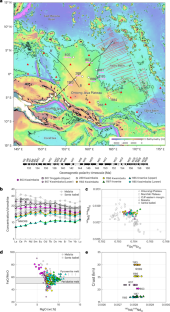
The Ontong Java Plateau, mainly emplaced during the Early Cretaceous on the Pacific Plate, is the most voluminous extant oceanic plateau. The exceptional volume and flux of magma that formed this plateau is widely thought to result from melting induced by a hot, buoyant mantle plume head; however, a purely thermal plume predicts uplift to above sea level, inconsistent with the plateau’s mostly submarine emplacement. An alternative formation mechanism is rapid seafloor spreading inducing decompression melting of a mantle portion with a relatively high proportion of dense fusible component. Here we use thermodynamic models simulating decompression melting of heterogeneous mantle sources to constrain the mantle potential temperatures and dense fusible mantle proportions required to form the Ontong Java Plateau under mantle plume and seafloor spreading scenarios. We show that the seafloor spreading model requires an unreasonably high mantle potential temperature or dense fusible pyroxenite proportion. By contrast, a thermochemical plume, with a temperature 135–200 °C higher than ambient mantle and up to 13% dense fusible pyroxenite, can explain not only the spatial variations in crustal thickness and lava compositions of the plateau, but also its mostly submarine emplacement. Thus, we propose that the formation of this plateau is best explained by a thermochemical mantle plume.