2026-07-16 東京大学
バナジウム中の水素原子の古典的もしくは量子的振る舞い
<関連情報>
結晶対称性の低下がプロトントンネル効果に及ぼす影響 Impact of crystal symmetry lowering on proton tunneling
S. S. Das,T. Ozawa,T. Kawauchi,H. Nakanishi & K. Fukutani
Nature Communications Published:15 July 2026
DOI:https://doi.org/10.1038/s41467-026-75020-w
Abstract
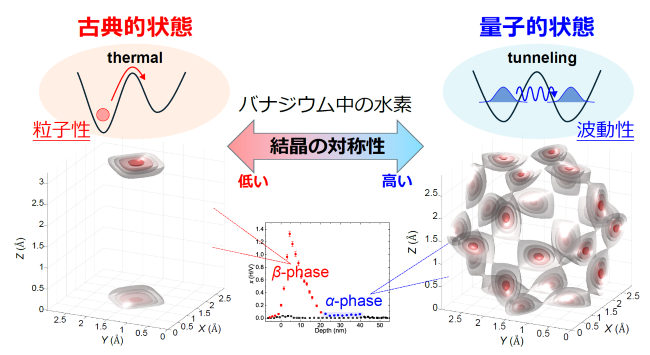
Considerable research has focused on the technological applications of vanadium-based materials for hydrogen (H) storage and separation. However, a fundamental understanding of H diffusion, particularly the role of crystal symmetry in its quantum behavior, remains incomplete. Here, we investigate H diffusion in an epitaxial vanadium (V) thin film through a combined approach involving structure analysis, hopping rate measurements, and quantum calculations. Nuclear reaction analysis of H depth profiles and lattice-site occupancy shows that H migration initiates around 70 K between the octahedral (Oz) sites in the uniaxially strained β-phase. The time evolution of electrical resistance, driven by changes in H distribution, enables quantitative estimation of the diffusion coefficient. Above 65 K, H exhibits thermally activated hopping with an activation energy of 148 meV. In contrast, in the cubic α-phase, H hopping remains significantly faster even at lower temperatures. Quantum state calculations reveal that, in the α-phase, H ground states are delocalized over tetrahedral sites due to tunneling, whereas in the β-phase, uniaxial strain suppresses tunneling, leading to localization around the Oz sites. These findings demonstrate that crystal symmetry plays a crucial role in quantum tunneling and, together with H-induced modulation of the potential energy landscape, governs phase-dependent H hopping behavior.