2026-07-08 ワシントン州立大学(WSU)
<関連情報>
- https://news.wsu.edu/press-release/2026/07/08/quiet-please-hatchery-salmon-raised-amid-noise-are-less-likely-to-return-to-spawn/
- https://academic.oup.com/najfm/advance-article/doi/10.1093/najfmt/vqag023/8703750
孵化場で飼育されたキングサーモンの発育、行動、および回帰率に対する騒音の影響の評価 Evaluating the effect of noise on the development, behavior, and return rates in hatchery-reared Chinook Salmon
Rikeem K Sholes,Teyline McLean,Alexandra Pederson,Susannah Schloss,Olivia Molano,Jonah Piovia-Scott,Allison B Coffin
North American Journal of Fisheries Management Published:08 June 2026
DOI:https://doi.org/10.1093/najfmt/vqag023
Abstract
Objective
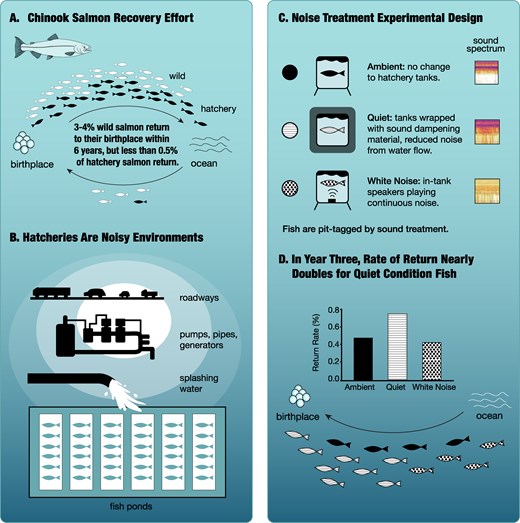
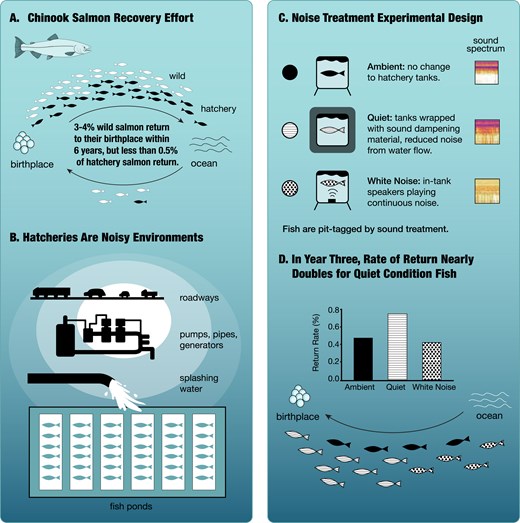
The National Fish Hatchery System’s role in supplementing declining fish populations is critical to achieve U.S. conservation objectives. However, hatchery-reared fish often exhibit lower fitness and survival compared with their wild counterparts. This difference is potentially due to environmental factors that are unique to hatchery environments. We sought to understand the relationship between hatchery-derived noise and early rearing habitat on the development, sensory physiology, swim performance, and survival of Chinook Salmon Oncorhynchus tshawytscha.
Methods
Before first feeding, juvenile Chinook Salmon were reared in two different rearing habitats (Heath trays and Redd Boxes). After feeding began, fry were transferred to enclosures with one of three noise conditions: quiet (noise abated), ambient hatchery noise, and continuous white noise treatment (150 dB [referenced to 1 μPa]). During each month (February–April), we analyzed growth metrics, brain-to-body-weight ratios, lateral line neuromast number, and inner ear cell counts. In April (prerelease), we also analyzed swimming performance and then tagged and released fish to quantify adult return rates.
Results
We observed moderate differences in fish length in April, shortly before fish were released. Neither sensory development nor swimming behavior was substantially impacted by rearing environment or noise exposure. However, we saw significant differences in return rates between noise treatment groups. We found that fry exposed to continuous white noise were significantly less likely to return to the hatchery, whereas fish in the quiet and ambient noise treatments had higher return rates.
Conclusions
Our findings indicate that chronic high-intensity noise exposure in hatcheries can negatively affect return rates of hatchery-reared Chinook Salmon, highlighting the importance of soundscape management to optimize fish fitness.