2026-06-26 中国科学院(CAS)
<関連情報>
- https://english.cas.cn/newsroom/research-news/202607/t20260708_1176651.shtml
- https://academic.oup.com/mnras/article/549/2/stag904/8676728?login=false
プランク衛星による低温コア のホルムアルデヒド観測 Formaldehyde observations of Planck cold cores
Ernar Imanaly,Jarken Esimbek,Willem Baan,Gang Wu,Dilda Berdikhan,Dalei Li,Jianjun Zhou,Xindi Tang,Yuxin He,Toktarkhan Komesh,…
Monthly Notices of the Royal Astronomical Society Published:12 May 2026
DOI:https://doi.org/10.1093/mnras/stag904
ABSTRACT
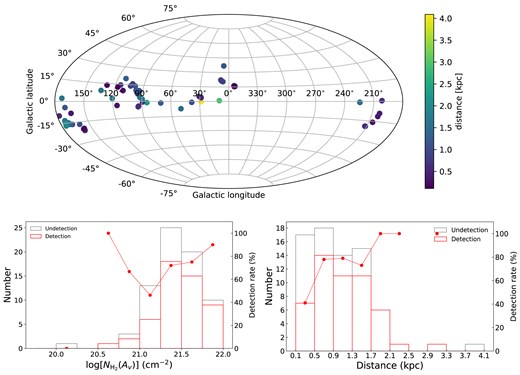
Single-pointing observations of 73 Planck cores from the Early Cold Core Catalogue with the Nanshan 26-m telescope are presented, targeting the H2CO (11,0–11,1) 4.8 GHz (λ∼6 cm) absorption line. H2CO absorption has been detected in 51 sources (69.9 per cent), with 24 sources (32.9 per cent) also showing components with hyperfine structure (HFS). In these 51 detected cores, non-thermal velocity dispersion dominates over thermal line broadening (σTH/σNT<1), with 96 per cent exhibiting supersonic turbulence (M>1). A weak correlation between σNT and Tkin suggests that turbulence contributes to gas heating. A strong σNT–ortho-H2CO column density correlation highlights the importance of both turbulence and gravity. For the 24 sources with resolved HFS, the derived excitation temperatures range from 2.08 to 2.59 K (mean 2.37 K). Follow-up mapping of four high signal-to-noise ratio cores with regions of resolved HFS components reveals widespread gas with Tex ≈2.36–2.64 K. Cores with resolved HFS exhibit narrower line widths, lower Mach numbers, higher column densities, and larger optical depths, indicating dynamically quiescent gas in clouds moving towards early gravitational collapse. In contrast, non-HFS regions surrounding the HFS regions in these sources display broader lines and stronger non-thermal motions, suggesting a dynamically complex environment where gravity begins to influence the earliest stages of star formation.