2026-07-03 中国科学院植物研究所(IB-CAS)
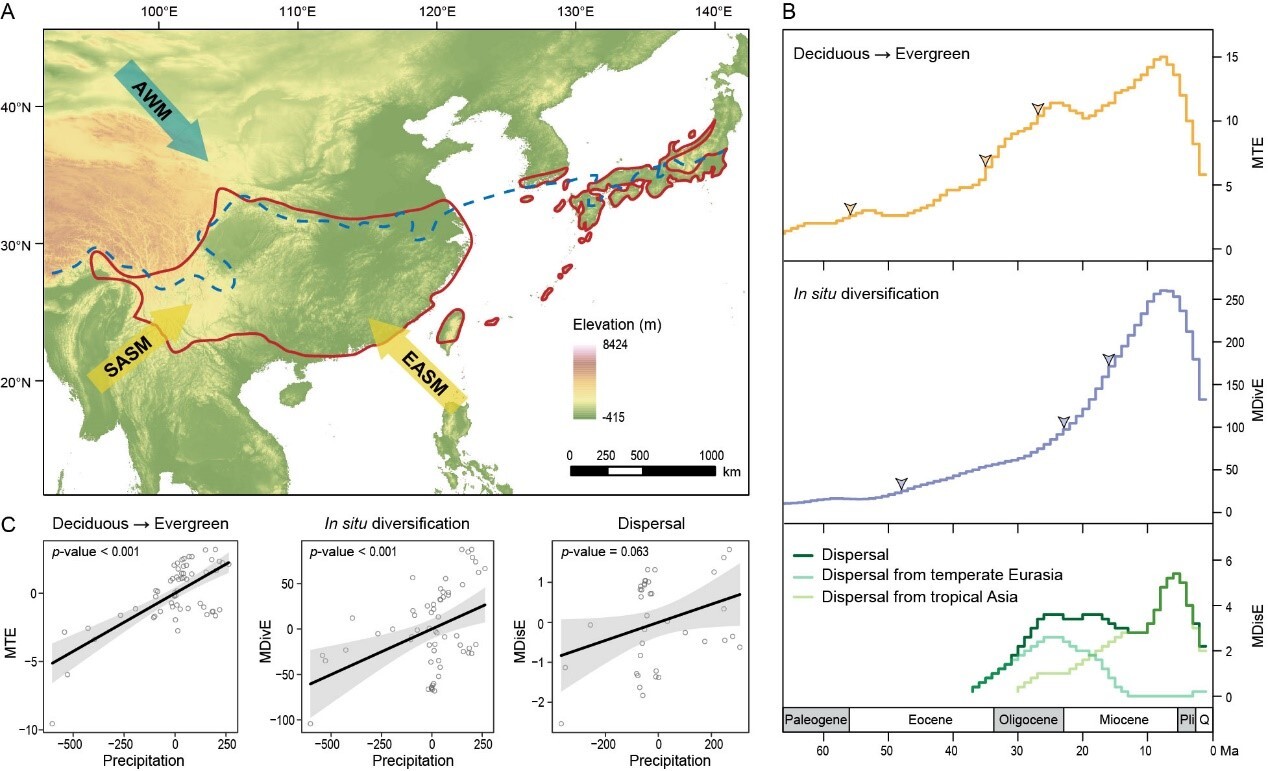
◆研究では、常緑種と落葉種を含む21の被子植物系統、2,028種を解析し、常緑系統の進化・分散・種分化の歴史を復元した。その結果、落葉性から常緑性への移行、地域内での種分化、外部からの移入はいずれも漸新世末~中新世初(OMB)に大きく増加し、中新世後期に最大となることが判明した。統計解析から、アジアモンスーン気候の成立と変動が森林形成を強く促進したことが示された。また、この森林の起源の一部は白亜紀にまで遡るものの、現在のような森林生態系への近代化はOMB以降に進み、中新世を通じて繁栄した一方、鮮新世以降は衰退したことが明らかになった。
◆東アジア常緑広葉樹林は、生物多様性を保存する「博物館」であると同時に新たな種を生み出す「ゆりかご」として機能し、温帯と熱帯を結ぶ生物交流の拠点でもあることから、保全上の重要性が強調された。
<関連情報>
- https://english.cas.cn/newsroom/research-news/202607/t20260702_1175191.shtml
- https://academic.oup.com/nsr/advance-article/doi/10.1093/nsr/nwag361/8707061
モンスーンによって形成された世界最大の常緑広葉樹林 Monsoon-driven assembly of the world’s largest evergreen broadleaved forest
Huan-Wen Peng,Lisi Hai,Xiao-Qian Li,Rosa del C Ortiz,Florian Jabbour,Wei Wang
National Science Review Published:12 June 2026
DOI:https://doi.org/10.1093/nsr/nwag361
Abstract
As the world’s largest evergreen broadleaved forest (EBLF), East Asian EBLF houses high levels of biodiversity and endemism and is essential to regional carbon storage and cycling. However, how East Asian EBLF was shaped over time remains an open question. Here we investigate the historical assembly of this biome by sampling 21 angiosperm clades (together encompassing 2028 species) that include evergreen and deciduous species. We show that the transition from deciduous to evergreen lineages, and in situ diversification and immigration of evergreen lineages in subtropical East Asia all experienced a dynamic process. Transition and immigration reached their first peaks and in situ diversification sharply increased at the Oligocene–Miocene boundary (OMB), and all of them reached their highest peaks in the late Miocene. Our results suggest that modern East Asian EBLF did not appear until the OMB and markedly deteriorated since the Pliocene, mainly driven by the evolution of Asian monsoon climate. This study suggests that East Asian EBLF has functioned as both museums and cradles for regional biodiversity, and serves as a transfer station for biotic exchanges between temperate and tropical regions, highlighting its great conservation value.