2026-07-08 合肥物質科学研究院(HFIPS)
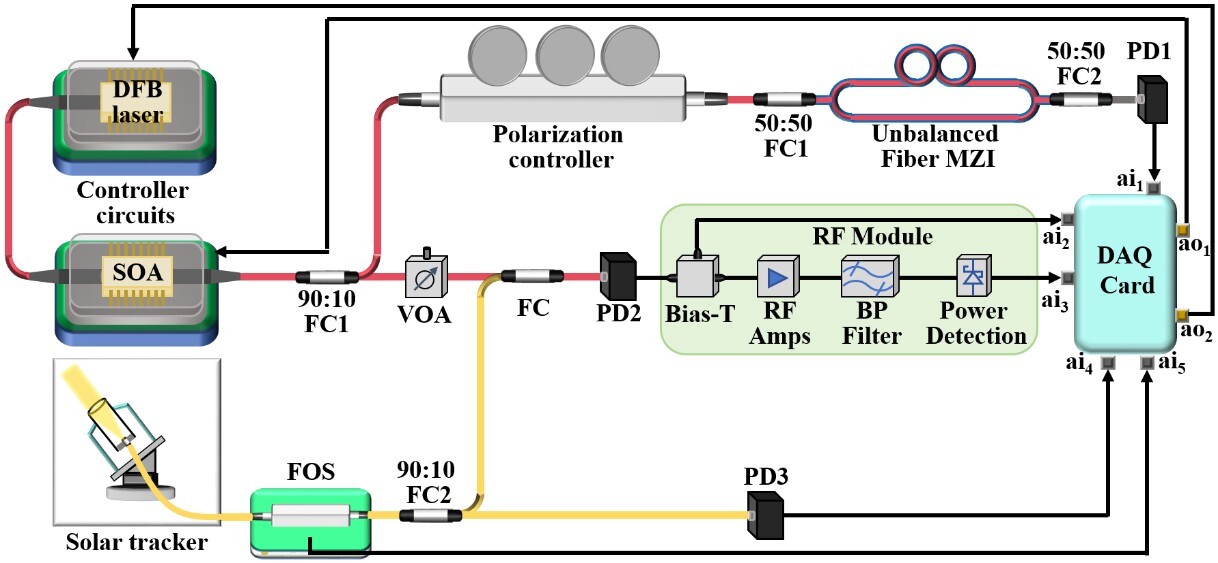
Schematic diagram of an all-fiber laser heterodyne radiometer with real-time wavelength calibration. (Image by TAN Tu)
<関連情報>
- https://english.hf.cas.cn/nr/rn/202607/t20260708_1176635.html
- https://opg.optica.org/ol/abstract.cfm?uri=ol-51-11-3084
- https://opg.optica.org/oe/fulltext.cfm?uri=oe-34-2-2253
- https://www.sciencedirect.com/science/article/abs/pii/S0030399225020158
上層大気観測用単側波帯分光分解能向上型レーザーヘテロダイン分光計 Single-sideband spectrally resolution-enhanced laser heterodyne spectrometer for upper atmospheric sensing
Jun Li, Guishi Wang, Kun Liu, Xiaoming Gao, and Tan Tu
Optics Letters Published: May 19, 2026
DOI:https://doi.org/10.1364/OL.600297
Abstract
A single-sideband laser heterodyne spectrometer (LHS) was developed for the first time, to the best of our knowledge. A multi-channel configuration employing different band-pass filters and frequency-shifted LOs achieves single-sideband detection at the hardware level, thereby eliminating the central dip distortion inherent in conventional dual-sideband LHS. The operation of the single-sideband LHS was analyzed and experimentally validated through optimization of the frequency shift of acousto-optic modulators and the bandwidth of radio-frequency filters, yielding a two-fold enhancement in spectral resolution. The performance of the single-sideband LHS was evaluated and validated through measurements of methane absorption spectra. The results demonstrate a significant improvement in spectral fidelity, with the error reduced by 64% compared with conventional dual-sideband LHS. The single-sideband LHS reported in this paper is expected to provide a powerful tool with high spectral resolution and high accuracy for remote sensing of upper atmospheric gases and planetary atmospheric molecules.
全光ファイバー不平衡マッハ・ツェンダー干渉計に基づくリアルタイム波長校正レーザーヘテロダイン放射計 Real-time wavelength-calibrated laser heterodyne radiometer based on an all-fiber unbalanced Mach-Zehnder interferometer
Jun Li, Jingjing Wang, Guishi Wang, Kun Liu, Xiaoming Gao, and Tu Tan
Optics Express Published: January 16, 2026
DOI:https://doi.org/10.1364/OE.581717
Abstract
Laser heterodyne spectroscopy is facilitating groundbreaking advances across multiple fields, including planetary atmospheric exploration, terrestrial greenhouse gas monitoring, wind field measurements, isotopic ratio analysis, and industrial gas emission monitoring. Nevertheless, Laser heterodyne radiometers (LHRs) lack effective wavelength calibration methods, which hinders their application in scenarios requiring miniaturization, high stability, and high precision. In this paper, what we believe to be a novel all-fiber LHR capable of real-time wavelength calibration is presented. The wavelength calibration scheme for this LHR was implemented using an all-fiber unbalanced Mach-Zehnder interferometer (MZI) combined with a corresponding wavelength calibration algorithm. Key performance-limiting factors of unbalanced MZI were experimentally analyzed. The criteria for determining the optimal optical path difference of the unbalanced MZI were established for the first time specifically for LHR applications. With a 22 cm unbalanced arm design, the system achieved a calibration resolution of 0.01623 cm-1 and demonstrated a calibration uncertainty of 2 × 10⁻⁵ cm-1 at an averaging time of 1s. Its performance was validated through absorption spectra measurements conducted in a gas cell. Field measurements of atmospheric CO2 absorption spectra were performed with the developed real-time wavelength-calibrated LHR. The unbalanced MZI wavelength calibration scheme not only provides a high-precision, environmentally robust frequency scale for laser heterodyne absorption spectroscopy but also exhibits great potential to serve as a reliable calibration solution for other high-resolution spectroscopic techniques.
高精度な大気中メタン( CH₄)検出のための高解像度フィールド展開型計測器、ラインシェイプ校正済みレーザーヘテロダイン放射計 High-resolution field deployable instrument line shape calibrated-laser heterodyne radiometer for accurate atmospheric methane (CH4) detection
Yun Zhang, Fengjiao Shen, Yu Wang, Zhengyue Xue, Jingjing Wang, Guishi Wang, Kun Liu, Xiaoming Gao, Tu Tan, Jun Li
Optics & leaser Technology Available online: 13 December 2025
DOI:https://doi.org/10.1016/j.optlastec.2025.114424
Highlights
- Development of a high-resolution LHR based on near-infrared laser heterodyne spectroscopy.
- Implementation of on-site calibration of ILS for LHR.
- The ILS-calibrated LHR is field deployable and more accurate.
- The ILS-calibrated LHR performance was verified by remote sensing of atmospheric methane (CH4).
Abstract
The performance of a near-infrared (NIR) high-resolution field deployable instrument line shape (ILS) calibrated-laser heterodyne radiometer (LHR) for accurate measurement of atmospheric CH4 column abundance is demonstrated. The ILS-calibrated LHR employs a distributed feedback (DFB) laser centered at 1653 nm to extract the CH4 absorption spectrum information in the atmospheric column from solar radiation. Based on the measured spectra and regularization deconvolution algorithm, the ILS of the LHR is accurately determined. Validation of the retrieved ILS is performed using low-pressure CH4 gas cell, and the accuracy is improved by 97 % compared to conventional ILS. Compared to traditional LHRs, the ILS-calibrated LHR leads to a 30 % reduction in residuals near the wings of the absorption lines and a 200 % reduction at the peak positions, resulting in a 10 % enhancement in the accuracy of the column abundance determination. The reported field deployable ILS-calibrated LHR provides valuable insights for the accurate measurement of greenhouse gases in Earth’s atmosphere.