2026-07-03 東北大学
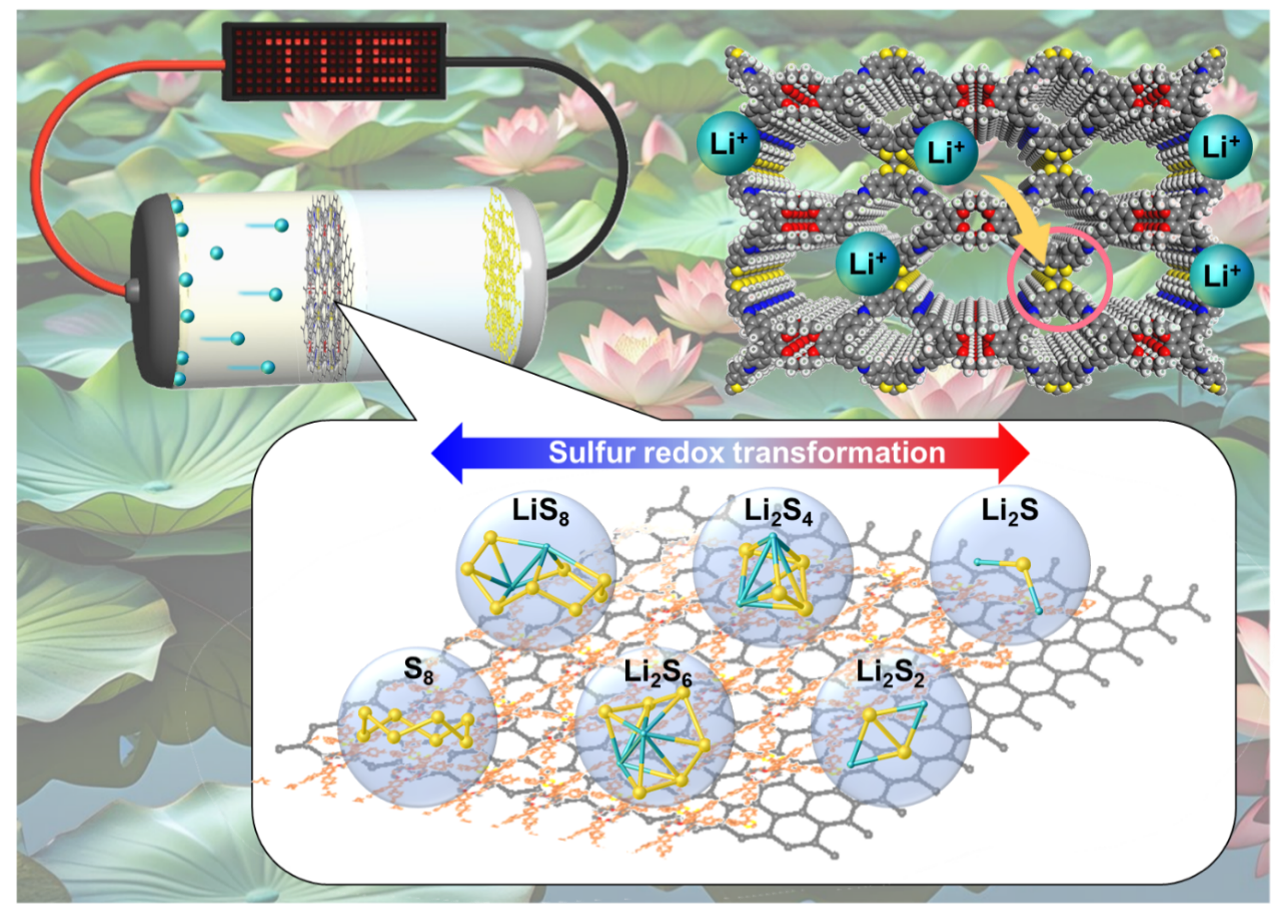
図1. TUS-44@G 機能界面層を備えたリチウム-硫黄(Li-S)電池の模式図。
<関連情報>
- https://www.tohoku.ac.jp/japanese/2026/07/press20260703-01-COF.html
- https://onlinelibrary.wiley.com/doi/10.1002/smll.74240
高レートリチウム硫黄電池向けテトラチアフルバレン-クラウンエーテルCOF@グラフェン層を介したポリ硫化物の固定化と硫黄変換速度の促進 Polysulfide Immobilization and Sulfur Conversion Kinetics Promotion via a Tetrathiafulvalene–Crown Ether COF@Graphene Layer for High-Rate Lithium–Sulfur Batteries
Kai Sun, Tsukasa Irie, Samim Reza, Kohki Sasaki, Mika Nozaki, Tokuhisa Kawawaki, Yujun Fu, Dequan Liu, Ranjit Thapa, Saikat Das, Deyan He, Yuichi Negishi
Small Published: 16 June 2026
DOI:https://doi.org/10.1002/smll.74240
ABSTRACT
The rational design of conversion-kinetics-promoting framework architectures offers a powerful strategy to overcome the polysulfide shuttling and sluggish conversion kinetics that limit lithium–sulfur (Li–S) batteries. Here, we report a new covalent organic framework, TUS-44, constructed from tetrathiafulvalene-based 4,4′,4”,4”’-([2,2′-bi(1,3-dithiolylidene)]-4,4′,5,5′-tetrayl)tetraaniline and benzo[18]crown-6-derived 4,4′,4′′,4′′′-(6,7,9,10,17,18,20,21-octahydrodibenzo[b,k][1,4,7,10,13,16]hexaoxacyclooctadecine-2,3,13,14-tetrayl) tetrabenzaldehyde linkers. The resulting imine-linked, π-conjugated framework integrates heteroatom-rich coordination sites within an electron-delocalized π-conjugated backbone, establishing a hierarchical, site-specific interaction network (N > O > S) that governs Li+ coordination, polysulfide anchoring, and dynamic charge redistribution. When coupled with conductive graphene to form an interfacial TUS-44@G architecture, the hybrid layer functions as a chemisorptive, conversion-kinetics-promoting interface that regulates soluble polysulfides, facilitates interfacial charge-transfer, and stabilizes intermediate species throughout cycling. This synergistic chemical–electronic coupling yields remarkable electrochemical performance: a high reversible capacity of 1455.7 mA h g−1 at 0.2 A g−1, excellent rate capability of 773 mA h g−1 at 10 A g−1, and outstanding durability with 0.034% capacity fading per cycle over 1000 cycles at 5 A g−1. A Li–S pouch cell incorporating TUS-44@G further delivers an outstanding initial energy density of ∼674 Wh kg−1 at 0.05 A g−1 (sulfur loading 44.558 mg), underscoring the practical potential of architecting conversion-catalytic framework interfaces for high-energy, durable Li–S batteries.