2026-07-01 ノースウェスタン大学
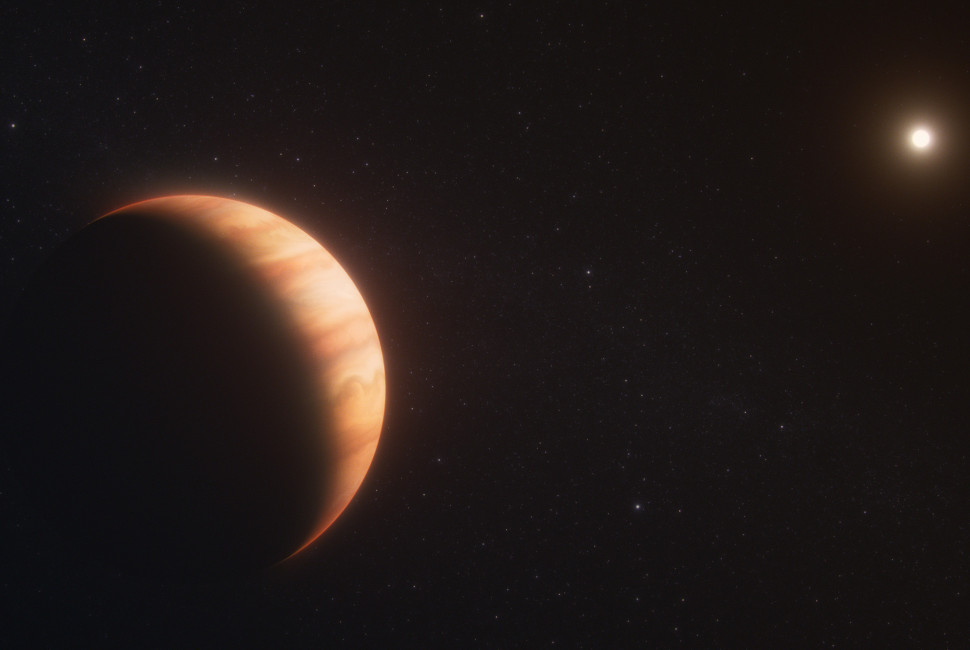
Artist concept of the gas giant planet WD1856b orbiting a white dwarf star. Image by NASA, ESA, CSA, Ralf Crawford
<関連情報>
- https://news.northwestern.edu/stories/2026/07/astronomers-discover-how-giant-planet-survived-its-stars-death
- https://www.nature.com/articles/s41586-026-10514-7
白色矮星の大気中のエアロゾルと炭化水素 Aerosols and hydrocarbons in the atmosphere of a white dwarf planet
Ryan J. MacDonald,Christopher E. O’Connor,Victoria A. Boehm,E. M. May,David K. Sing,Elijah Mullens,L. C. Mayorga,Trevor O. Foote,Simon Blouin,Logan A. Pearce,Nikole K. Lewis,Jeff Valenti,Natasha E. Batalha,Maura Lally,Joshua D. Lothringer,Mark S. Marley,Ishan Mishra & Susan E. Mullally
Nature Published:01 July 2026
DOI:https://doi.org/10.1038/s41586-026-10514-7
Abstract
Most stars, including our Sun, will one day evolve into red giants and, subsequently, white dwarfs. Several planet candidates have recently been identified orbiting white dwarfs1,2,3,4, demonstrating that planets can survive the stellar post-main-sequence stage intact. Little is known about the atmospheric composition of post-main-sequence planets, with the most evolved transiting planets with atmospheric detections so far orbiting subgiants5,6. Here we report an atmospheric detection for the white dwarf planet WD 1856 b, achieved through transmission spectroscopy with the James Webb Space Telescope (JWST) Near-Infrared Spectrograph (NIRSpec) PRISM. Our 0.5–5.0-μm spectrum reveals the presence of hydrocarbons (odds ratio of 167:1–5,377:1, with CH4 preferred at 17:1–30:1), aerosols (2 × 10⁵:1–2 × 10⁶:1) and thermal emission from the planetary nightside (2 × 1063:1–2 × 1073:1). Our spectral analysis constrains the mass of WD 1856 b to 4.3–10.9 MJ, finds a carbon-enriched atmosphere (with a CH4 abundance of approximately 7%) and an effective temperature exceeding the expected planetary equilibrium temperature (390–412 K versus 160 K). On the basis of cooling models, these results indicate that WD 1856 b underwent a migration-related reheating event 3.0–5.5 Gyr into the white dwarf phase, consistent with post-main-sequence tidal evolution to the present-day 0.02-au circular orbit. Our results provide a window into the ultimate fate of giant planets orbiting stars with masses similar to our Sun.