2026-06-30 東北大学
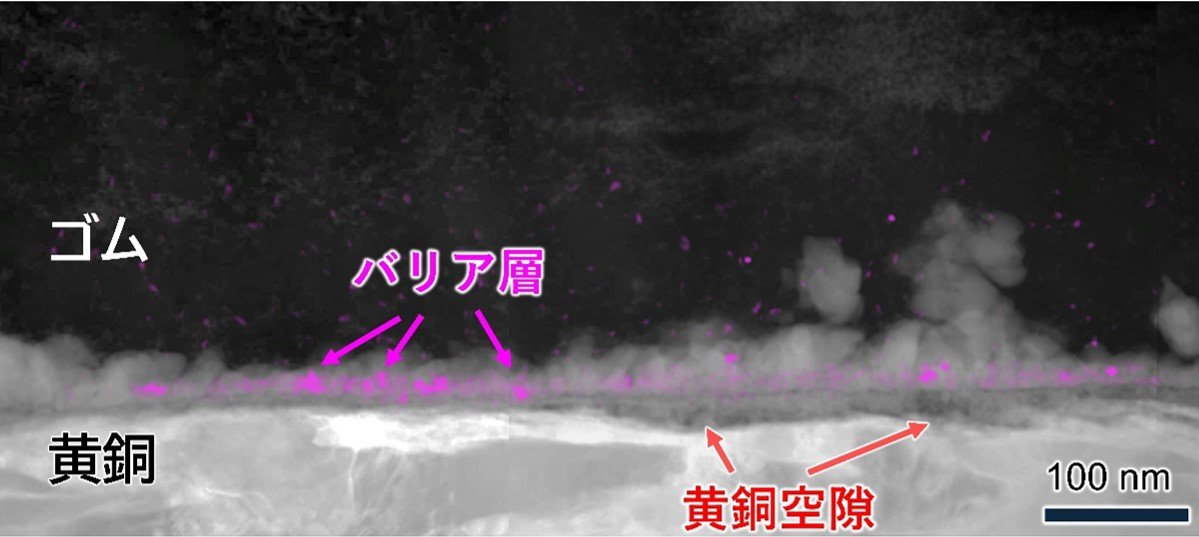
図1. 有機酸コバルトを添加したゴムと黄銅めっきスチールコードの接着界面の走査透過電子顕微鏡像(白黒表示)とコバルト分布(ピンク表示)。
<関連情報>
- https://www.tohoku.ac.jp/japanese/2026/06/press20260630-01-rubber.html
- https://rct.kglmeridian.com/view/journals/rcat/aop/article-10.5254-rct.25.00050/article-10.5254-rct.25.00050.xml
真鍮被覆鋼線とゴムの界面におけるコバルトのナノスケール分布と役割 Nanoscale distribution and role of cobalt at the interface between brass-coated steel wire and rubber
Yohei K. Sato, Tomohiro Miyata, and Katsunori Shimizu
Rubber Chemistry and Technology Published:05 Jun 2026
DOI:https://doi.org/10.5254/rct.25.00050
ABSTRACT
Incorporating Co organic acids into rubber improves the adhesion between rubber and brass-coated steel wire, a mechanism that is essential for tire safety; however, the details by which these acids improve the adhesion are unknown. We fabricated Co organic acid–containing rubber composites with brass-coated wires and analyzed their adhesive interfaces by using scanning transmission electron microscopy (STEM), revealing the adhesion-enhancing role of Co organic acids at the atomic and nanoscale levels. Elemental mapping by energy-dispersive X-ray spectroscopy provided the first direct visualization of local Co enrichment at the rubber–brass interface. Furthermore, STEM combined with electron energy-loss spectroscopy analyzed the chemical states at the interface, revealing divalent Co2+ in the form of sulfides (CoxSy). These findings suggest that Co reacts with sulfur during vulcanization to form inorganic crystals that cover the surfaces of the brass-coated wires, suppressing the diffusion of Cu and Zn from brass into rubber and the associated void formation within the brass layer. Even after hydrothermal aging, Co remains localized at the interface and continues to suppress the growth of both interfacial and depletion layers. Suppression of Cu/Zn diffusion and void formation, mitigating cohesive fracture within the brass layers on steel wires, should be a primary mechanism by which Co acids enhance rubber adhesion to steel wires and prevent their deterioration under harsh environmental conditions.