
2026-06-24 ジョージア工科大学
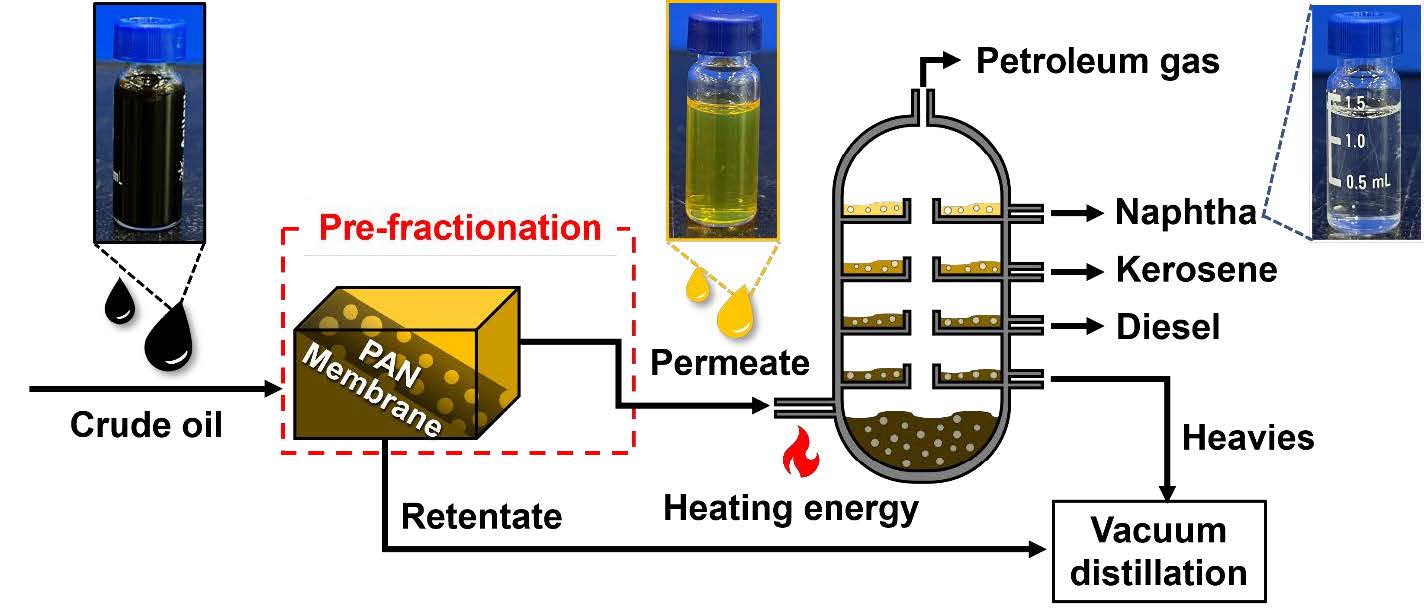
Schematic illustration of the membrane-based pre-fractionation process, showing the selective separation of light hydrocarbon fractions from crude oil feedstock to reduce energy requirements for subsequent atmospheric distillation.
<関連情報>
- https://research.gatech.edu/researchers-discover-membrane-based-approach-more-sustainable-oil-refining
- https://www.nature.com/articles/s41586-026-10677-3
ソポーラスポリアクリロニトリル膜を用いた原油分画 Crude oil fractionation by means of mesoporous polyacrylonitrile membranes
Jihoon Choi,Hyeokjun Seo,Minyong Lee,Woong-Chul Shin,Jaemin Choi,Keonwoo Choi,Min-Jun Jang,Sung Gap Im,Jae W. Lee,Ryan P. Lively & Dong-Yeun Koh
Nature Published:24 June 2026
DOI:https://doi.org/10.1038/s41586-026-10677-3
Abstract
Atmospheric and vacuum distillation consume more than 1,100 TWh year−1 and emit more than 160 million metric tonnes of CO2 equivalent annually1,2, making membrane-based pre-fractionation a compelling retrofit strategy for lowering the energy and carbon intensity of petroleum refining3,4,5,6,7,8,9,10. Here we demonstrate that porous polyacrylonitrile (PAN) membranes, typically used as support layers, achieve effective molecular refining of crude oil at steady state. Under tangential flow, PAN membranes exhibited high crude oil permeances of up to 0.591 ± 0.040 l m−2 h−1 bar−1, a more than 23-fold increase over the previous benchmark (<0.1 l m−2 h−1 bar−1)1,11, selectively yielding enriched lighter hydrocarbon fractions such as naphtha and kerosene. This unexpected selectivity arises from the dynamic deposition of heavy hydrocarbons within the initially approximately 15-nm surface mesopores, which narrows the pore diameter to sub-2-nm dimensions. Depth-resolved chemical identification reveals selective accumulation of n-alkanes, suggesting a self-limiting pore constriction mechanism that stabilizes selective transport pathways. Once the n-alkane deposition is stabilized, selective enrichment of raw crude oils occurs with sustained stability over 4 weeks. Process simulations show that PAN-membrane-based pre-fractionation could reduce energy by 31.6%, cooling water by 20.7% and CO2 emissions by 37.6% compared with traditional atmospheric distillation.

