2026-06-26 東北大学
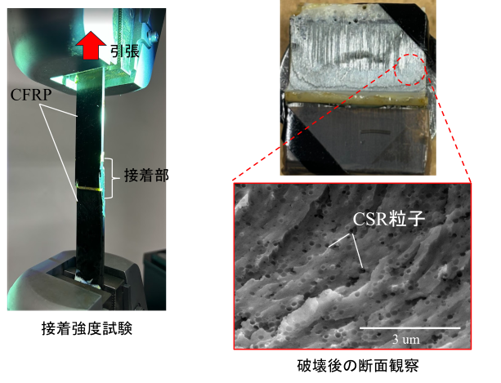
図1. 本研究で実施した接着強度試験。破壊後の接着面にはCSR粒子の痕がみられる。
<関連情報>
- https://www.tohoku.ac.jp/japanese/2026/06/press20260626-03-cfrp.html
- https://www.sciencedirect.com/science/article/pii/S0020768326003318
微視的損傷モデルに基づく熱硬化性樹脂の強化に関するマルチスケールモデリング:接着CFRP構造への応用 Multiscale modeling of toughening in thermosetting resins based on a microscopic damage model: Application to bonded CFRP structures
Yamato Hoshikawa, Sera Koo, Yoshiaki Kawagoe, Shoko Mishima, Kazuki Ryuzono, Tomonaga Okabe
International Journal of Solids and Structures Available online: 15 June 2026
DOI:https://doi.org/10.1016/j.ijsolstr.2026.114159
Highlights
- SLS strength of thermosetting resin reinforced with CSR particles was investigated.
- Bottom-up multiscale analysis demonstrated the underlying strengthening mechanism.
- Top-down analysis elucidated fracture processes around CSR particles in SLS tests.
Abstract
In this study, the toughening mechanisms induced by the addition of nanoparticles to an epoxy resin were modeled using a multiscale modeling framework, and a strategy was proposed to predict the bonding strength of structural adhesives containing toughening agents. An epoxy adhesive modified with core–shell rubber (CSR) particles was investigated through tensile and compressive tests of the resin and single-lap shear (SLS) tests using carbon-fiber-reinforced plastic (CFRP) adherends. The experimental results demonstrated a significant improvement in SLS strength despite reductions in the resin stiffness and strength, with the maximum shear strength observed at 5 wt% CSR content.
To elucidate the underlying strengthening mechanism, a bottom-up multiscale analysis was conducted by combining a microscale continuous damage mechanics (CDM) model with a macroscale enhanced smeared crack model (SCM). At the microscale, void growth and plastic deformation in the epoxy matrix surrounding CSR particles were modeled using periodic unit cell (PUC) analysis. The resulting homogenized elastic–plastic properties and fracture toughness were incorporated into a macroscale finite element model of the SLS test. Furthermore, a top-down approach was employed to map the macroscopic strain history within the adhesive layer onto the microscale analysis, enabling a detailed evaluation of the process zone formation. The proposed framework reasonably captured the overall changes in the stress–strain response of the resin and the SLS strength associated with CSR addition. The results demonstrated that the toughness enhancement was primarily governed by plastic deformation and void coalescence in the epoxy matrix.
These findings establish a methodology for predicting the mechanical properties that explicitly accounts for inclusion-induced toughening mechanisms in adhesives, thereby contributing to the development of tailored adhesive design strategies for bonded structures.