2026-06-17 サンディア国立研究所(SNL)
<関連情報>
- https://newsreleases.sandia.gov/in-the-mountain-west-a-quantum-computing-collaboration-announces-major-results/
- https://www.nature.com/articles/s41586-026-10676-4
全対全接続性を備えた98量子ビットのトラップイオン型量子コンピュータ A 98-qubit trapped-ion quantum computer with all-to-all connectivity
Anthony Ransford,M. S. Allman,Jake Arkinstall,J. P. Campora III,Samuel F. Cooper,Robert D. Delaney,Joan M. Dreiling,Brian Estey,Caroline Figgatt,Alex Hall,Ali A. Husain,Akhil Isanaka,Colin J. Kennedy,Nikhil Kotibhaskar,Ivaylo S. Madjarov,Karl Mayer,Alistair R. Milne,Annie J. Park,Adam P. Reed,Riley Ancona,Molly P. Andersen,Pablo Andres-Martinez,Will Angenent,Liz Argueta,… Justin G. Bohnet
Nature Published:17 June 2026
DOI:https://doi.org/10.1038/s41586-026-10676-4
Abstract
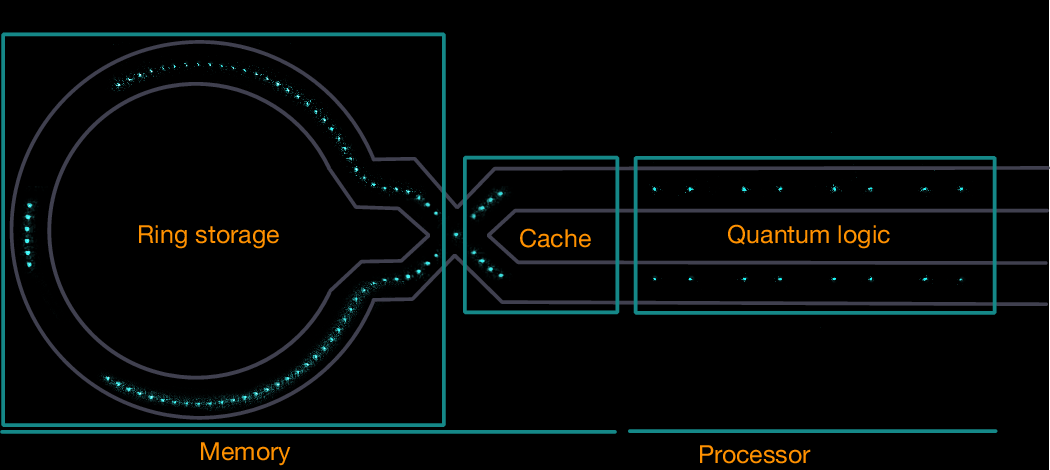
Quantum computers require both high-fidelity operations and large qubit numbers to surpass classical capabilities1. Trapped-ion platforms have demonstrated the highest gate fidelities of any modality2,3,4,5,6 but scaling to larger qubit numbers while preserving performance has remained a central challenge. We report on Quantinuum Helios, a 98-qubit trapped-ion quantum processor based on the quantum charge-coupled device (QCCD) architecture7. Helios features 137Ba+ hyperfine qubits8,9, all-to-all connectivity enabled by a rotatable ion storage ring connecting two quantum operation regions by a junction10,11, speed improvements from parallelized operations12 and a new software stack with real-time compilation of dynamic programs13. Averaged over all operational zones in the system, we achieve average infidelities of 2.5(1) × 10−5 for single-qubit (1Q) gates, 7.9(2) × 10−4 for two-qubit (2Q) gates and 3.3(5) × 10−4 for state preparation and measurement (SPAM), none of which are fundamentally limited and probably able to be improved. These component infidelities are predictive of system-level performance in both random Clifford circuits and random circuit sampling (RCS), the latter demonstrating that Helios operates well beyond the reach of classical simulation and establishes a new frontier of fidelity and complexity for quantum computers14.