2026-06-17 中国科学院(CAS)
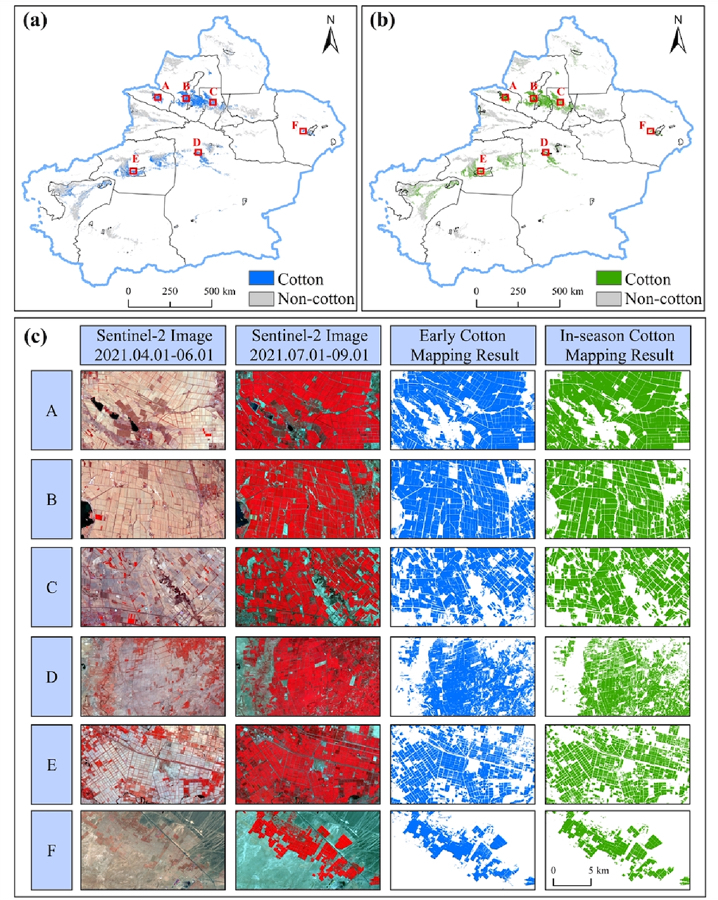
Early-season maps of cotton in Xinjiang: (a) early-season mapping; (b) in-season mapping; (c) spatial details of cotton maps for six selected regions. (Image by AIR)
<関連情報>
- https://english.cas.cn/newsroom/research-news/202606/t20260617_1174045.shtml
- https://www.sciencedirect.com/science/article/abs/pii/S0034425726001860
新疆における独自の機械化プラスチックマルチング技術による綿畑の生育時期の早期特定 Advancing the earliest identifiable timing of cotton fields by the unique mechanized plastic-mulching practices in Xinjiang
Rubing Zeng, Changping Huang, Junru Zhou, Qiushuang Yao, Letao Lan, Huihan Wang, Mi Yang, Ze Zhang, Yaokai Liu, Qingxi Tong
Remote Sensing of Environment Available online: 2 May 2026
DOI:https://doi.org/10.1016/j.rse.2026.115416
Highlights
- Cotton field has higher plastic-mulched (PM) fraction than other crops in Xinjiang.
- An early-season cotton mapping method based on unique PM practices was developed.
- Earliest Identifiable Timing of cotton in Xinjiang is advanced to mulching stage.
- The proposed mapping method facilitates time-sensitive agricultural decision-making.
Abstract
As a globally significant cash crop, cotton requires timely monitoring. Early-season mapping of cotton in Xinjiang is critical for applications such as irrigation scheduling and agricultural insurance. Current methods, which largely depend on physiological and phenological cues detectable post-canopy development, fall short of supporting truly early-season demands. To this end, this study proposed a novel mapping approach that advances the Earliest Identifiable Timing (EIT) to the sowing-seedling stage by harnessing differences between cotton and other crops in cultivation practices, specifically the prevalent use of mechanized plastic-mulching technology in Xinjiang. Our analysis of 10 m Sentinel-2 imagery revealed that cotton fields exhibited a significantly higher plastic-mulched (PM) fraction within mixed pixels relative to other crops. Based on this, we constructed a feature set from spectral and textural signatures to capture PM-related differences and trained a random forest classifier for early-season cotton mapping. While this method showed a marginal accuracy decrease compared to in-season phenology-based mapping, it greatly improves timeliness. The proposed method advanced the EIT to the plastic-mulching stage (approximately 4–4.5 months before harvest), with an overall accuracy of 84.70% and a cotton F1-score of 88.16%. By exploiting early cultivation practice signatures, this study facilitated much earlier identification of cotton in Xinjiang, offering valuable information for time-sensitive agricultural decision-making.